.jpg)
Your search for the best interactive demo platform for product marketing and GTM teams has come down to Navattic vs. Storylane, and now you need to answer one key question:
Which is better for your use case?
This article breaks down both platforms’ key features, pros and cons, and pricing to help you make a confident decision.
And if neither option fully fits what you’re looking for, we’ll also introduce a third alternative - Arcade - that takes a different approach by recording your real product and easily transforming it into demos, videos, and other campaign-ready assets.
Don’t like reading long articles? Here’s a quick overview of our findings. ⤵️
💡 If you prefer firsthand experience, give Arcade a try today.
TL;DR
- Navattic and Storylane are HTML-first interactive demo platforms that emphasize post-capture customization, but typically require more setup time and hands-on editing.
- Arcade takes a record-first approach, letting teams capture real web and desktop product interactions and use AI to turn that single capture into interactive demos, polished videos, and campaign visuals.
- Arcade is the most flexible option for fast-moving product marketing teams because one capture can be reused across multiple formats.
- Storylane offers the widest range of native integrations, though Navattic and Arcade cover most core GTM tools.
- Arcade provides the best value for teams creating multiple demos and assets, while Navattic is the most expensive at scale.
What do Navattic and Storylane have in common?
Both Navattic and Storylane offer HTML-based options for building demos. These let you capture a replica of your product and customize it further for your audience.
Storylane provides a more intuitive experience than Navattic and includes features for taking product screenshots and videos and capturing HTML .

Navattic’s capture, on the other hand, is entirely HTML-oriented. It lets you create product demos one capture at a time, which makes the entire process long and complicated—particularly when it comes to more complex demos. You can upload images, PDFs, and videos.

Additionally, both platforms have steep learning curves—especially Navattic—and longer deployment times compared to solutions like Arcade, which lets you record your product in real-time and captures your interactions throughout the recording.
At a glance: Arcade vs. Navattic vs. Storylane
Let’s look at each tool’s features to better understand what each can do for you.
Features - Navattic vs Storylane vs Arcade
When it comes to key features, all 3 platforms have functionalities that set them apart:
- Arcade lets you record both web and desktop apps to create image- and video-based steps, then reuse that capture across interactive demos, videos, and visuals. Key features include real-time recording, brand-aware AI, GIF/video exports, commenting, and flexible personalization and editing.
- Navattic offers a no-code HTML demo builder with in-app suggestions to guide demo creation. While it provides deep post-capture customization, demos are built primarily from screenshots, making the process more manual and time-consuming. Key features include offline demos, rich customization, checklists, and analytics.
- Storylane provides an image-based HTML editor similar to Navattic, with a smoother overall user experience. Key features include version history, presenter notes, and tools designed for sales-led demo workflows.
Let’s walk through these tools’ features in more detail. 👇
Arcade’s Top Features
Feature #1: Flexible demo creation
Arcade lets teams capture their real product and turn those interactions into interactive demos, videos, and visuals - without recreating the same product flow for different formats.
Arcade supports several ways to create product demos, depending on what you’re starting with:
- Real-time product recording, where Arcade captures clicks, navigation, and user actions, and automatically converts them into interactive steps with hotspots
- Screenshot-based demo building, allowing teams to stitch together step-by-step walkthroughs when recording isn’t ideal
Media uploads, including existing screenshots and videos, which can be converted into interactive demo steps
However, Arcade has a few more tricks up its sleeve.
Firstly, in addition to a Chrome extension that lets you record web apps, Arcade also has a desktop app to record:
- Desktop apps
- Terminal apps
- Multiple tabs and screens
💡 This might sound minor, but it consolidates your entire workflow. Now there’s no need for you to have multiple tools to record screens, capture screenshots, build demos, and polish the final product.
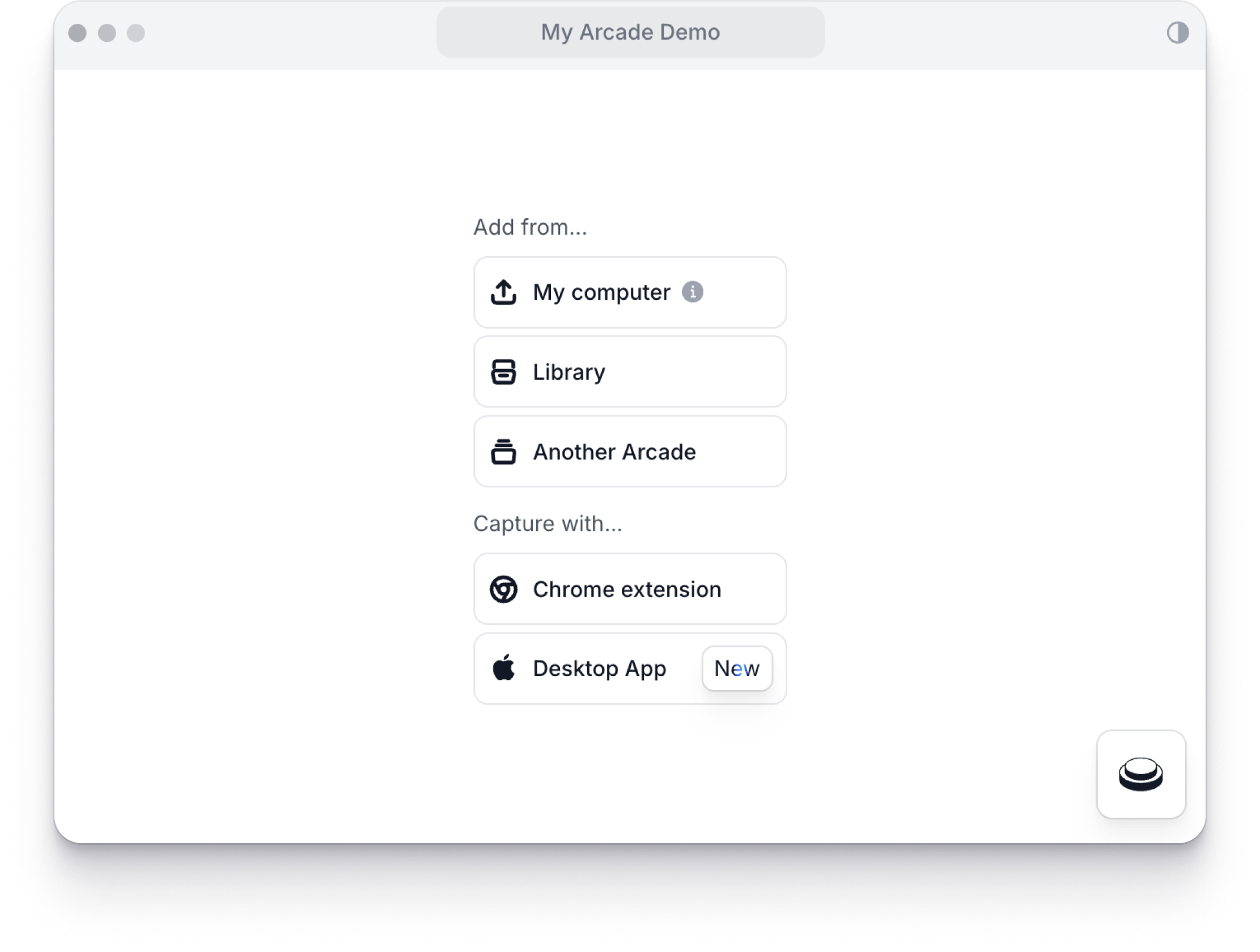
❗Pro Tip: This approach works especially well for showcasing mobile app experiences or bringing existing demo assets into Arcade.
Feature #2: Visual Polish and Editing
Arcade customers care about creating interactive demos that seamlessly fit their brand, like the example below from HackTheBox ⤵️

Arcade includes a broad set of editing tools that make it easy to shape the story you want to tell, including:
- Pan and zoom: Guide viewer attention to specific UI elements or details without needing video editing experience.
- Chapters: Organize longer demos into navigable sections that let viewers jump to what matters most to them.
- Branching paths: Let viewers choose their own journey through your demo based on role, use case, or features they care about.
- Custom variables: Insert dynamic placeholders like company name, user role, or industry to make each demo feel tailored to the viewer.
- Page Morph: Edit text, images, or data directly in your demo without re-recording - useful for hiding sensitive information or showing different scenarios.
- Avery AI: Get contextual copy suggestions for hotspots and callouts as you build, with options for promotional or educational tones.
- Blurring and redaction: Hide confidential data or UI elements you're not ready to show, then publish updated versions without starting over.
- AI voiceovers: Add professional narration in 30+ languages to make demos more accessible and engaging.
Video editing: Transform uploaded videos into interactive steps by trimming clips, adjusting speed, or converting footage into static images.
Plus, updates made by anyone on your team sync automatically across every channel where your demo is embedded or shared. This means your customer base is always getting the freshest version of your content available.
Feature #3: Brand-aware AI for product storytelling
Arcade’s AI is designed specifically for product marketing, grounded in your brand and your product instead of generic templates.
At the core of Arcade’s Creator Studio is a context engine that builds a living Brand Kit from your website and existing content, capturing:
- Typography, colors, and layout patterns
- Visual hierarchy and spacing
- Voice and tone
That brand context is applied automatically across everything you create, reducing the need for designers to clean up or rework assets.
As teams scale content across launches, campaigns, and personas, this prevents brand drift and ensures every asset looks and feels consistent, even when created by different people.
Key AI-powered capabilities of Arcade include:
- AI video generation, which transforms product captures into polished videos with music, transitions, and effects
- AI visual generation, used to create campaign assets, screenshots, and marketing visuals directly from product recordings
- Avery AI writing assistant, which generates contextual copy for hotspots and steps during demo creation
- Page Morph, which allows teams to modify HTML elements or explore variations without re-recording the entire flow
The result of all of the above is content that designers can trust without needing to be involved in every small change, like fixing typography, aligning colors, or polishing layouts to match brand guidelines.
Feature #4: Advanced personalization, sharing, and performance insights
Personalization is key to success in today’s competitive market and applies to product demos. Crafting a tailored demo for each lead or customer will give them a brand experience they won’t easily forget.
However, doing it at scale is challenging with Storylane and Navattic.
Once demos are created, Arcade makes it easy to distribute and measure them:
- Custom variables and links allow teams to personalize demos at view time (e.g., name, company, role)
- Flexible sharing options, including direct links, website embeds, collections, and campaign distribution
- Export options, such as high-quality videos, GIFs, and images for use across channels
Arcade also provides built-in insights that allow companies to capture relevant information for further conversations, including:
- Forms embedded at key moments to capture lead data
- Audience Reveal, which identifies companies engaging with demos, even without form fills
- Engagement analytics, showing views, drop-off points, and interaction patterns
- CRM integrations, like HubSpot and Salesforce, to sync demo engagement with pipeline data
Try out personalization here. 👇
Feature #5: Demos that stay current
Arcade keeps pace with fast-moving products.
Instead of forcing teams to re-record demos every time the UI changes, Arcade includes an automated update system that:
- Replays demo steps directly inside the live application
- Safely simulates real user actions rather than relying on static recordings
- Applies updates without rebuilding demos from scratch
- Supports human review before updates go live
This helps teams maintain accurate, up-to-date product stories without constant manual rework.
Finally, all of you reading this article on your phones are probably wondering if Arcade’s demos are mobile-friendly.
In short, yes.
Arcade’s demos are optimized for mobile phones, meaning they will be automatically adjusted to all devices they’re viewed on.
Arcade is the right choice if you:
✅ Care about visual polish and on-brand output.
✅ Want to turn your actual product into demos, videos, and visuals.
✅ Need brand-aware AI that applies design automatically.
✅ Want to reuse one capture across demos, videos, and exports.
✅ Need fast deployment (median setup time: 6 minutes).
✅ Want demos that stay up to date as your product changes.
✅ Need solid analytics to understand engagement.
Arcade isn’t the best option if you:
❌ Want an HTML-based demo builder.
❌ Need highly personalized customization of editing elements.
Want to see Arcade in action?
Click below to watch the best Arcade from growing products, curated by our team 👇

Navattic’s Top Features
Feature #1: No-code interface for building interactive demos via HTML
Navattic lets you build interactive demos via its no-code interface by cloning your application and enabling you to take screenshots of how you interact with it.

To speed the process up, Navattic also offers an AI Copilot that can generate an initial demo structure, suggest copy, and place tooltips as you capture your product, reducing some of the manual setup involved in building HTML-based demos.
Although this approach is useful if you need to showcase very complex products and features, taking screenshots at each step can still be time-consuming, especially for longer or frequently changing flows.
This is the primary way to create demos in Navattic. There are no options for recording real-time product videos or capturing live interactions as you can with Arcade.
Feature #2: Demo suggestions
This is a handy option for beginners, as the platform will deliver actionable suggestions during demo building.
For instance, if your demo is too long or short, omits CTAs, or has other shortcomings, Navattic will draw your attention to it.

Feature #3: Analytics
Thanks to a wide range of native integrations, Navattic can reveal the companies that watch your demo and enrich them with firmographic data.
That way, you can see which key accounts engage with your product demo and pass them on to the Marketing and Sales teams.
Moreover, its analytics platform shows how prospects interact with your demo, highlighting insights such as time spent on each step, CTA clicks, drop-off, etc.
Navattic is the right choice if you:
✅ Want to build demos with HTML.
✅ Need granular insights on who’s watching your demos and how they engage with them.
Navattic isn’t the best option if you:
❌ Need mobile-optimized demos.
❌ Want more flexible options for recording and designing tours, such as video recording, rich media, etc.
❌ Need more advanced exporting and personalization options.
❌ Want to include voiceovers or translate into different languages.
.jpeg)
Storylane’s Top Features
Feature #1: More options for building demos
Although Storylane is very similar to Navattic in terms of essential product offerings, it includes a few more options for creating demos.
Namely, it also lets you capture screenshots and add videos.
Unlike Arcade, Storylane’s Chrome extension doesn’t let you record videos of scrolling and typing motions in your product.
As a result, its demo building experience isn’t as seamless as Arcade’s, although it’s much simpler and smoother than Navattic’s.
Feature #2: Secure sharing
Storylane lets you secure your demos with passcodes and special restrictions (e.g., give access only to viewers who provide their email addresses).

This is especially useful for capturing leads or protecting sensitive product information.
Moreover, you can create expiring interactive demos that will disappear once completed or after a specified period.
Feature #3 Presenter Notes
This is a useful feature when giving prospects a live product tour.
Namely, with Storylane, you can create personalized interactive demos that your sales and presales reps will use to showcase your product.

Presenter Notes enable you to add tips, reminders, and instructions to specific steps, ensuring that your sales reps will give the best possible presentation every time.
Storylane is the best choice if you:
✅ Want a product similar to Navattic that’s easier to use.
✅ Need both HTML and screen capture options.
✅ Robust integration options.
Storylane isn’t the best option if you:
❌ Don’t want to deal with its steep learning curve.
❌ Want more flexibility when creating demos (e.g., video recording, pan & zoom).
❌ Want more personalization options with voiceovers, camera recording, and translations.
Integrations - Navattic vs Storylane vs Arcade
Arcade’s Integrations
Although Arcade has fewer integrations than Navattic, it does integrate with all the must-have tools needed for your product demos to reach the right audience and engage them, such as:
- Clearbit to uncover companies that interact with your demos.
- Slack to notify your team when a new Arcade has been published, edited, or viewed by certain accounts.
- HubSpot and Salesforce to integrate with your CRM systems.
- Mixpanel to track and analyze audience behavior.
- And many more.

Navattic’s Integrations
Navattic integrates with similar platforms like Arcade, including HubSpot, Marketo, Salesforce, Slack, etc.

However, its integrations are slightly more advanced in certain aspects.
For example, you can connect with MadKudu for deeper lead-related integrations and Zapier to trigger other workflows.
Storylane’s Integrations
Storylane has more integrations than Navattic and Arcade, such as Gmail, Miro, Gitbook, Intercom, etc.

Pricing - Navattic vs Storylane vs Arcade
Price is one of the most important factors when buying interactive demo software.
You don’t want to pick a solution that seems affordable at first but will cost you too much at scale, or one that’s too expensive for what you really need.
Therefore, we’ll offer a detailed breakdown of each platform’s pricing structure to help you determine the value for money each provides.
Here’s a quick breakdown of the key takeaways:
- Arcade offers the strongest value for money, with a usable free plan and flexible monthly or annual pricing that scales from individuals to teams.
- Navattic is the most expensive option, with pricing that ramps up quickly for advanced features and is primarily geared toward mid-to-large teams.
- Storylane is priced between the two. It offers a free plan and more flexibility than Navattic, but becomes significantly more expensive than Arcade as team size and feature needs grow.
Arcade Pricing
Arcade's free tier lets you build and distribute up to three demos with live product recording and synthetic voiceovers, which is enough to explore the platform before upgrading.
When you're ready for unlimited demos and expanded customization, choose from one of three premium plans:
- Pro: $32/month for unlimited demos, unlocks editing tools like pan and zoom, blur effects, watermark removal, basic analytics, and the ability to export as GIF or MP4.
- Growth: $42.50/user/month for teams, with everything in Pro plus collaboration features, white labeling, advanced branching logic, granular permissions, and deeper engagement insights.
- Enterprise: Custom pricing designed for organizations that need enterprise-grade security, role-based access, dedicated customer success management, branded domains, and custom analytics dashboards.
While Growth and Enterprise unlock the full feature set, Pro provides enough flexibility for individuals and small teams getting started.
Arcade supports both monthly and annual billing, so you're not locked into long-term contracts upfront.

Navattic Pricing:
Navattic has five pricing tiers:
- Starter: Free, 1 seat, and 1 interactive demo with unlimited views and basic analytics
- Starter Plus: $40/month, unlimited screenshot and video demos with basic integrations and customization
- Base: $500/month, HTML demos, multiple seats, all integrations, advanced demo engagement tools, and suggestions
- Growth: $1,000/month, advanced analytics, personalization, A/B testing, collaboration, and enterprise-ready controls
- Enterprise: Custom pricing, offline demos, enhanced security, audit logs, and dedicated support
Storylane Pricing
Storylane has a free plan that lets you publish one live demo with unlimited shares and views.
For more, you can subscribe to one of 4 plans:
- Starter: $40 per creator per month, lets you create unlimited demos using screenshots and videos.
- Growth: $500 per month, 5 users, lets you create demos using screenshots, videos, and HTML, and includes personalization tokens, all integrations, and custom lead forms.
- Premium: $1,200 per month, 10 seats, includes everything in Growth plus Buyer Hub, SSO, dedicated support, and several “built for sales” features (presenter demos, deal intelligence, etc.).
Enterprise: Custom pricing and number of users, includes everything in Growth, plus stronger security, branding features, and ongoing coaching.
What are the customers saying about Navattic vs Storylane vs Arcade?
It’s one thing to hear it from u, and another to hear it from long-term customers of each platform.
We sifted through reputable rating sites and forums to see how customers talk about Arcade, Navattic, and Storylane.
So, let’s look at a few customer reviews for each platform ⤵️
Arcade Reviews
🎯 TL;DR: Arcade’s users find the platform intuitive and easy to use. The demos they create with it are visually attractive and apt for engaging various audience types, from stakeholders and business partners to leads and team members. Customers also appreciate Arcade’s transparent roadmap and dedication to constant improvements.

“It is easy to use and very intuitive; offers a great number of features for personal use or for collaboration among teams.
It is easy to implement, and it integrates well with some common browsers.
Arcade offers exceptional insights into views and interactions with published arcades, which is quite a powerful feature.
Finally, I see several improvements in a short time, which tells me that Developers and Engineers are actively working on it, implementing and expanding new features.” - Source

“Arcade is extremely helpful for us as a way of recording and automating solution demos. We've been creating Arcade for use in our own marketing and pre-sales activities, and interestingly enough, we've also created Arcades for our certified partners to use in their own initiatives - with specific branding, CTAs, and information relevant to their respective audiences…
It's been very easy to implement - install the browser extension, hit record, edit the tour, and ship it out.
I can't say much about Customer Support because we simply haven't required support. It's so easy to use. But we've been in contact with product engineering regarding feature requests and they've been extremely helpful and delivered new functionality in remarkably short time.” - Source

“Gone are the days of having to screenshot and manually annotate software. Arcade makes it so easy to record actions and instruct people on how to use the software. Every single person I've shown it to is like "Wow, this is so useful."
I'd recommend it to anyone who has to make trainings/SOPs for any software-driven workflow.” - Source
Navattic Reviews
🎯 TL;DR: Navattic customers like that the platform offers post-capture customization options and lets you build demos without using code. However, many mention that its demos are not mobile-friendly and that building demos is time-consuming.

“UI could be improved (some things not as intuitive), mobile view still seems to be very clunky. Web capture edits don't always apply. Would be helpful if we could choose specifically where the tooltips go on a web capture. Full view for demos are great but would be nice if there were more mobile view options that don't require manually recreating a new tour (i.e like Arcade)” - Source

“I find creating the demos to be time-consuming. Looking forward to where the product can go, I'd love to see more automated elements -- like being able to record me going through an entire website, automatically capturing all the screens, and building demos that recreate my click-thru motions that I can edit as needed.” - Source
Storylane Reviews
🎯 TL;DR: Storylane’s users like its ease of use and customization options the most. However, its lack of real-time product video recording, disconnect of product galleries between demos, and less intuitive UI are cited as common downsides.

“Would be great to have the ability to take full-screen captures of browser windows so you could scroll up and down pages, but not at all a deal breaker for me.” - Source

“It could be a little easier to embed into things like websites and email.” - Source

“Storylane makes it incredibly easy to create demos. Its high level of customization ensures that the colors and appearance can be tailored to achieve stunning results.
However, it is a bit on the expensive side.” - Source
Ready to pick one?
Navattic, Storylane, and Arcade each serve different needs, and the right choice depends on how you want to create and maintain your content.
Navattic and Storylane make sense for teams that prefer building demos through structured editing after capture rather than recording live product flows.
Arcade takes a different approach. Instead of rebuilding demos step by step, teams record their real product once and use brand-aware AI to turn that capture into interactive demos, polished videos, and campaign-ready visuals, all from the same workflow.
As a result, Arcade is especially well-suited for fast-moving GTM teams that need on-brand assets without long setup cycles.
If you’re looking for a flexible, cost-effective way to keep product demos and visuals up to date as your product evolves, Arcade is the strongest option.
Sounds like your solution?
Sign up for Arcade’s free plan, and create compelling interactive demos today.
FAQs
What’s the main difference between Arcade, Navattic, and Storylane?
Navattic and Storylane are primarily capture-and-edit demo platforms (HTML and/or media-based) with strong post-capture customization.
Arcade emphasizes record-first workflows and repurposing outputs.
Is Arcade only for interactive demos?
No. Interactive demos are core, but Arcade Creator Studio supports broader product storytelling by turning a single product capture into interactive guides, polished videos, campaign visuals, screenshots, and sales assets without rebuilding the same flow in multiple tools.
Which platform is best for fast-moving products?
Arcade is best-suited for fast-moving products. Its automated demo update system helps keep content in sync as your UI changes, reducing the need to constantly re-record or rebuild demos.
HTML-based tools typically require more manual updates when products evolve.
When would Navattic or Storylane be a better choice?
Navattic or Storylane can be a better fit if you specifically want an HTML-based demo-builder with deep post-capture customization, or if your demos are highly structured and don’t need real-time product recording, videos, or AI-powered content generation.
Share on