.jpg)
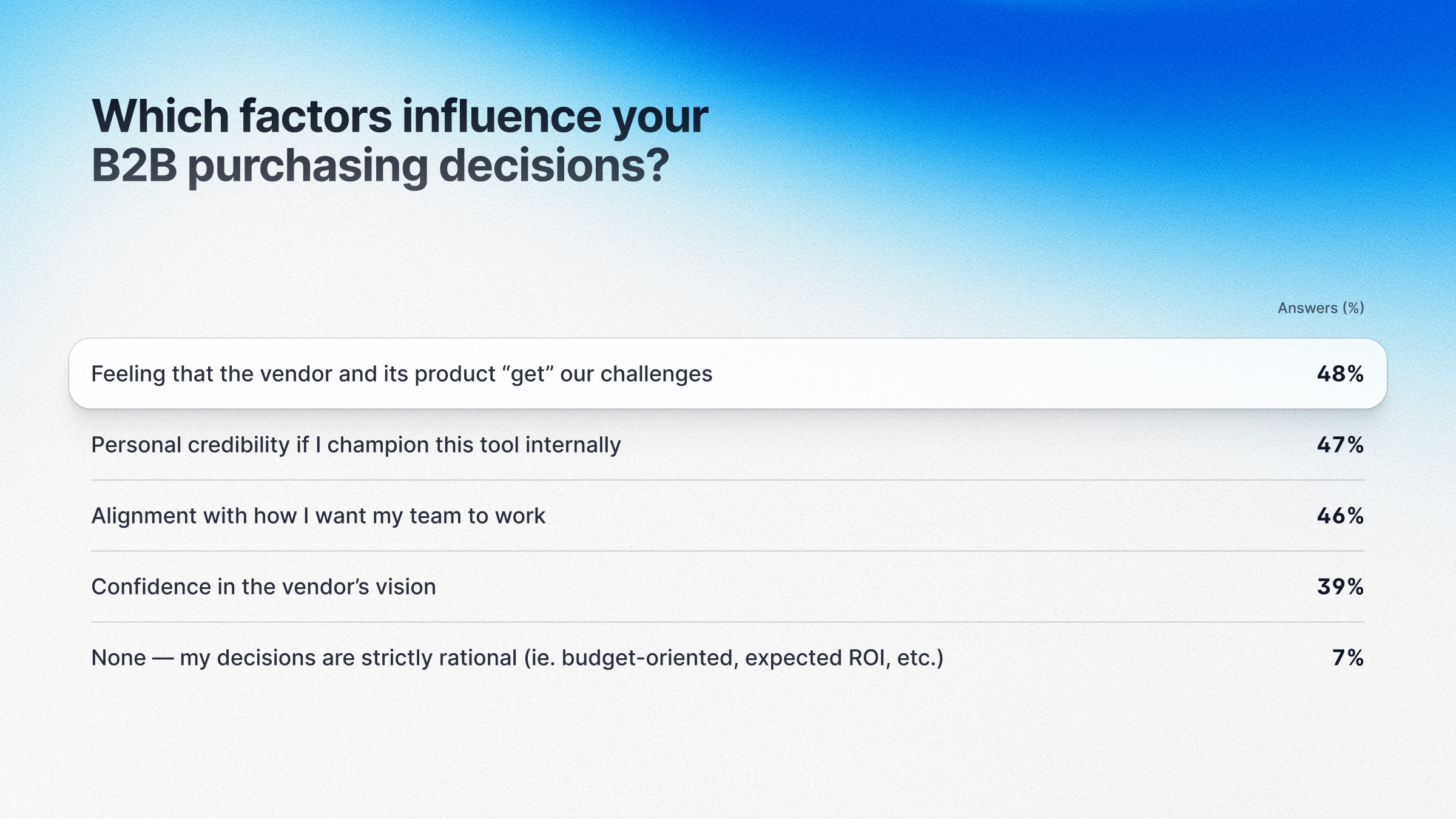
We discovered that the #1 factor isn't features, price, or ROI; it's whether buyers feel the vendor truly understands their challenges (48% agree). We also found that while what buyers want can vary by the software’s price point, all segments are looking for empathy, compelling stories, and hands-on, practical proof.
Yes, pricing matters (69% said it influenced their decision). And yes, features matter (56% cited them as important). But here's the gap most vendors miss: only 17% said a product's approach actually felt differentiated enough to move them forward.
That's not a feature problem. It's a storytelling problem.
Methodology
This report is based on a survey of 600 B2B software buyers who’ve made a purchasing decision as part of their job in the past year. Price points ranged from less than $100/month to more than $12,000/year (approximately $1,000/month).
Key Findings:
1. What Kills Trust Is Universal. What Builds It? That Depends.
TL;DR: Match your content style to your buyer segment, but never sacrifice substance. Candid works for SMB/PLG; polish works for enterprise – but jargon, buzzwords, and vague claims fail everywhere.
When buyers ranked what most damages their trust in marketing content, exaggerated claims and scripted, inauthentic content topped the list. And when asked what makes them immediately disengage, nearly half cited excessive jargon or buzzwords, 45% tune out overused AI language without clear relevance, and 35% reject vague value propositions like "drive down costs" or "boost efficiency." The through-line is that buyers at every level want substance.
The conventional wisdom in B2B marketing is that professional polish signals credibility. Buyers want to see that you're a serious vendor with resources, expertise, and staying power. And for some buyers, that's absolutely true.
But the data reveals a more nuanced reality: what builds trust depends heavily on what buyers are buying – and specifically, how much they're spending. What kills trust, however, is remarkably consistent across all segments.
Content Preferences Vary by Price Point
When we asked buyers which type of content makes them trust a B2B vendor more, overall responses were nearly evenly split:
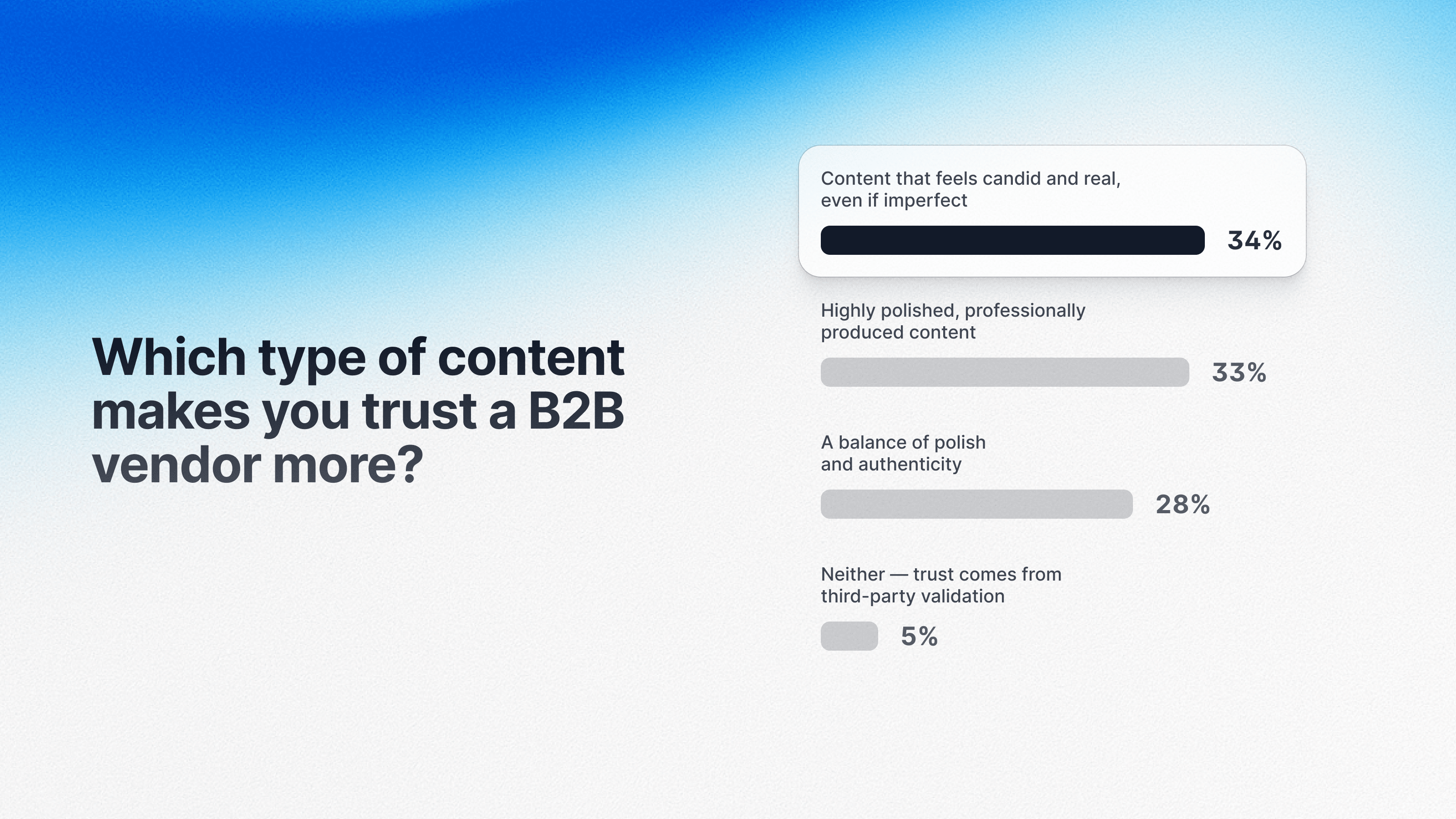
But when we segment by price point, a striking pattern emerges. As purchase price increases, preference shifts from candid authenticity to professional polish:
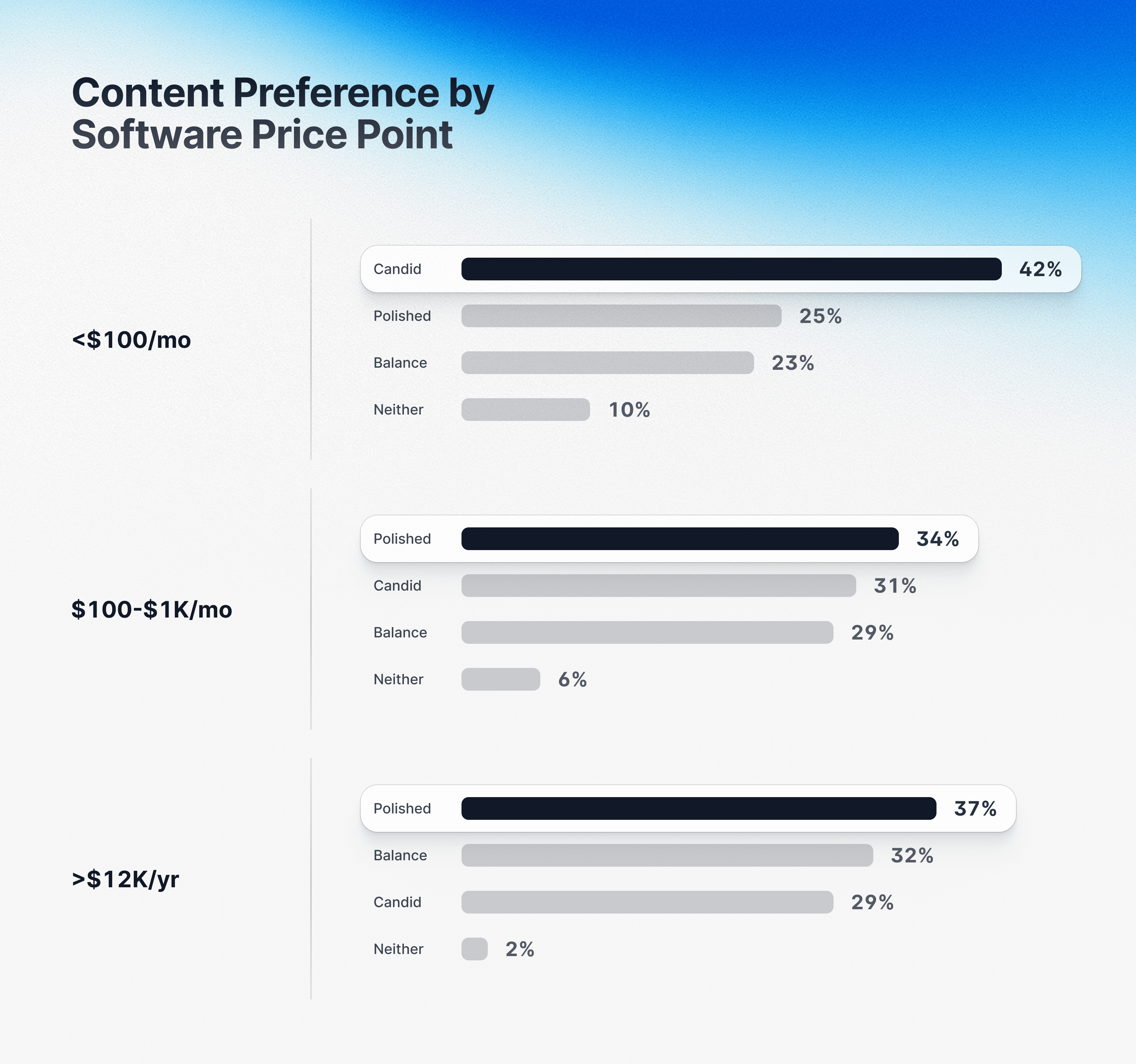
At the lower end, more buyers prefer candid, real content – even if that means it’s imperfect. Meanwhile, preference for highly polished content grows alongside the price point.
This isn't surprising when you consider the buying context. A $50/month tool is often an individual contributor decision with minimal internal justification needed. Buyers at this level are skeptical of marketing spend and prefer authenticity – they want to see the product is built by real people solving real problems, not a faceless corporation pushing generic enterprise software.
Once you get up to $500/month, however, the decision likely requires stakeholder buy-in and a business case. At $12K+/year, buyers need professional credibility signals to justify larger purchases internally and defend their decision if challenged. Polish isn't vanity at this level – it's risk mitigation.
What Alienates Buyers Across the Board
While content preferences vary by price point, what undermines trust is remarkably consistent. When we asked buyers to rank what most damages their trust in marketing content, exaggerated claims and scripted, inauthentic content tied at the top of the list.
But when asked what makes them immediately disengage – what actually causes them to bounce from content – the results paint an even clearer picture:

The top three disengagement triggers are all variations on the same theme: hollow marketing speak. Excessive jargon and buzzwords, overused AI language without clear relevance, and vague value propositions all signal to buyers that the vendor is more interested in sounding impressive than being helpful.
The 47% who cite "overuse of AI language without clear relevance" is particularly striking in 2026. Simply adding "AI-powered" to your messaging no longer sets you apart. Buyers want to know what the AI actually does for them, not just that it’s baked in.
The through-line across both trust-building and trust-killing is substance. Whether buyers want candid or polished presentation, they universally reject hollow marketing speak. They want specificity, clarity, and honesty. The packaging varies by segment, but the expectation for substance doesn't.
Implications for B2B GTM
If you're selling PLG tools or targeting SMBs:
- Lean into authenticity. Raw behind-the-scenes content, founder-led videos, and candid discussions of your product journey will resonate more than over-produced marketing.
If you're selling to mid-market or enterprise:
- Maintain professional polish. Your buyers need credibility signals to justify larger purchases internally.
Regardless of segment:
- Eliminate buzzwords, vague value propositions, and AI jargon without clear relevance. These are universal trust-killers.
- Focus on specificity and clarity. Show concrete examples. Explain exactly how your product works and what it enables.
- The bar isn't perfection – it's honesty and usefulness.
This aligns with what we see in actual product demo performance: In a recent analysis of over 14 million interactive demo sessions, those that relied on generic “marketing speak” had the lowest completion rates. Buyers don't just say they hate buzzwords – they actively disengage when they encounter them.
2. Stop Differentiating Features. Start Showing Better Futures.
TL;DR: Buyers don't want you to prove how you “stand out” via an ongoing feature list; they need to envision how their outcomes will be better with your solution.
Buyers absolutely compare features and pricing. They create spreadsheets, build competitive matrices, and evaluate your capabilities against alternatives. But here's what most vendors miss: that comparison isn't what tips the decision.
When we asked buyers what made them move a product forward in their consideration, the results were telling:
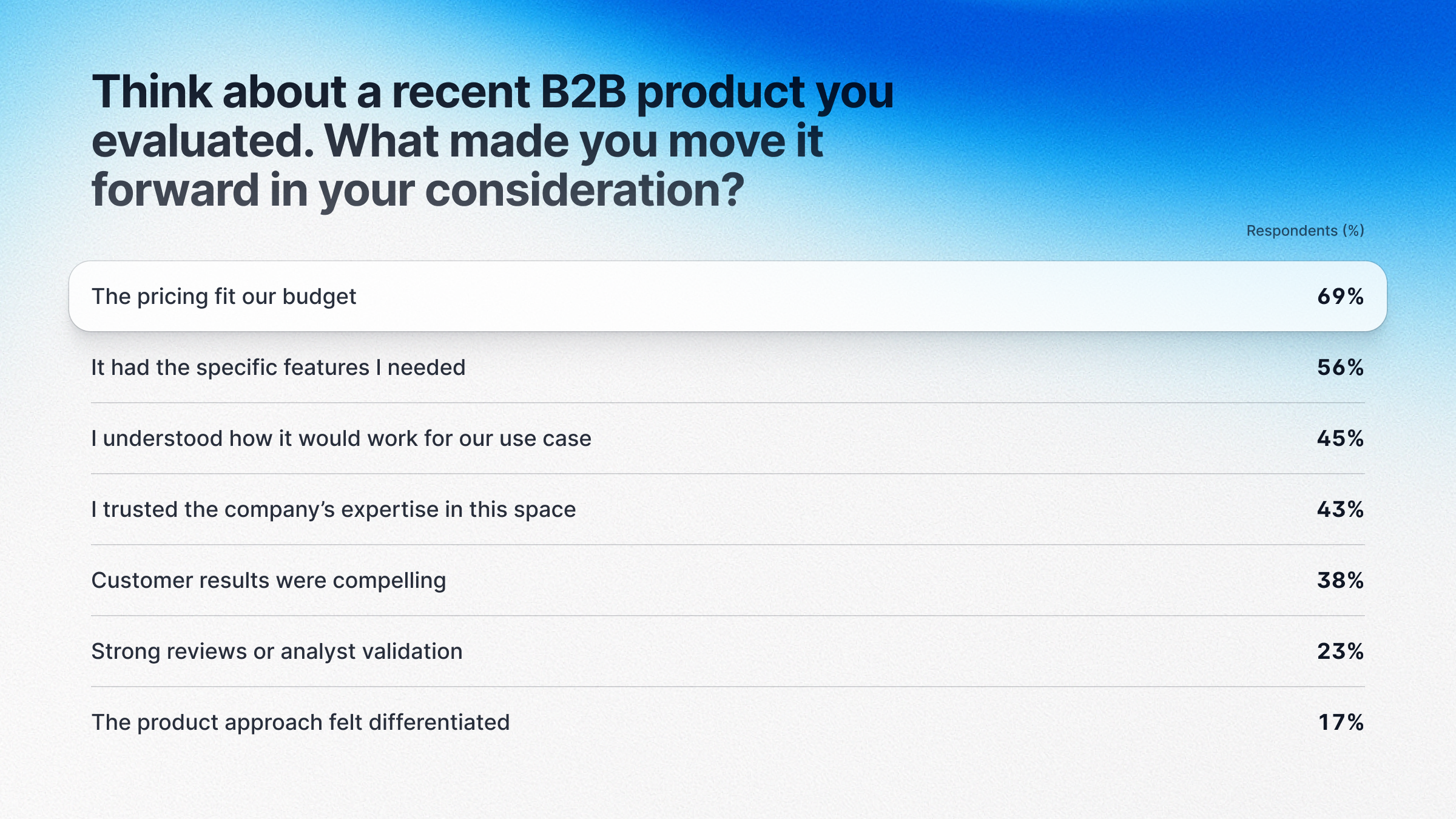
Pricing and features do top the list – but the real surprise is at the bottom: only 17% said they moved forward because "the product approach felt differentiated."
Buyers will absolutely evaluate your features and compare your pricing – those are table stakes. What makes them choose you is in how you help them see a better future.
The conventional wisdom in B2B is that differentiation drives decisions. Vendors obsess over competitive matrices and proving their approach is unique: "We're the only platform that ABC." or "Unlike our competitors, we XYZ."
Buyers, however, are telling us something different.
What Actually Tips the Scale
When asked what tips their preference if two products have comparable features and pricing, buyers ranked ease of use as the most influential factor.
This is revealing. When everything else is equal, buyers don't want to hear about your unique architecture or proprietary approach. They want to know: "How hard will this be to actually use?" and "How painful will it be to get up and running?"
This is why communicating how your product actually works to solve your buyer’s biggest challenges matters more than communicating why it's different at a features, functionality, or pricing level.
Show, Don't Tell
When we asked buyers to rank what makes marketing content genuinely useful, the top two factors were:
- #1: “Clear explanation of how the product works in practice”
- #2: “Specific examples tied to real use cases”
Buyers don't want to hear that you're innovative or cutting-edge – they want to see the proof that your product delivers better outcomes. They want product stories that help them picture their own success, and interactive demo experiences that walk through the workflows they'll actually experience.
If you can articulate your buyer's problem better than they can, you've demonstrated you understand their world. You've earned credibility not through feature differentiation, but through empathy and vision.
This is story differentiation.
Vendors who lead with "We're different because..." are answering a much bigger question in isolation. The question buyers really want the answer to is: "Will this make my life better, and how can I be confident it will work?"
Implications for B2B GTM
- That only 17% of buyers say a product "feeling differentiated" moves them forward should be a wake-up call. Stop treating competitive positioning decks as your biggest asset.
- Start with a stronger product story that demonstrates a deep understanding of the buyer's challenges, puts them at the heart as the "hero", and makes the value immediately clear. That's what earns attention and keeps you in the conversation.
- When buyers are weighing similar options, they search for confidence in execution. They want to understand how the product will fit into their workflow, how quickly it can deliver value, and how easy it will be to implement.
- A compelling story gets you in the door, but hands-on experience closes the deal. Don't just tell buyers what's possible – let them try it for themselves. Demos, trials, and interactive experiences are more impactful than pitch decks.
Speaking of..
3. Give Buyers Hands-On Access Earlier
TL;DR: A quarter of buyers surveyed want hands-on access immediately – before demos, case studies, or sales calls. Only 5% want to talk to sales early. Let buyers explore on their own terms and timeline. That's 1 in 20 buyers. The other 19? They want to self-educate.
When we asked buyers how they typically consume product information, the results were clear:
.png)
The largest single group (25%) wants hands-on access immediately. Not after a demo. Not after reading case studies. Not after a discovery call.
Immediately.
Only 18% start with on-demand videos or demos to "get the gist." Another 20% trust reviews and analyst opinions, and 16% look for proof from similar companies. Just 5% want to schedule time with a sales rep early in their evaluation.
The Self-Service Imperative
This preference for self-service exploration isn't just about convenience—it's about control and efficiency. Buyers want to:
- Evaluate on their own timeline (not yours)
- Form their own opinions (not be sold to)
- Test their specific use cases (not watch generic demos)
- Only engage with sales once they've decided the product is worth their time
Every gate you put between a buyer and your product – "request a demo," "talk to our team," "schedule a consultation" – creates friction. And in a world where 25% of buyers want immediate hands-on access, that friction costs you deals.
Implications for B2B GTM
- Reduce friction to access: Every form field, every "schedule a call" CTA, every gate between a buyer and your product is a conversion leak. Audit your buyer journey and ask: where are we making it harder than it needs to be?
- Design for the decision threshold: Our 2026 product demo benchmarks report shows that viewers who get past Step 7 in an interactive experience are 2.3 times more likely to complete it. Front-load your best content instead of burying value in later steps where most buyers will never see it.
- Make self-service actually useful: Offering a trial isn't enough if buyers don't know what to do with it. Provide guided onboarding, clear use case examples, and templates that help buyers see value quickly. Make sure your product is accessible and understandable without a sales rep walking buyers through it.
- Respect the timeline: Buyers will engage with sales when they're ready, not when you decide it's time. Stop forcing discovery calls on buyers who just want to explore. Let them raise their hand when they're ready to talk.
- For enterprise vendors: Even if you can't offer a full self-service trial, find ways to give buyers hands-on access earlier. Interactive demos, sandbox environments, or limited-access trials can bridge the gap.
4. Buyers Need to Feel Understood – Then Helped to Envision Success
TL;DR: The #1 factor influencing purchasing decisions isn't features or pricing—it's whether buyers feel the vendor "gets" their challenges (48%). Once understood, 88% need product stories to envision success. B2B buying is deeply human.
When we asked buyers which factors influence their purchasing decisions, the results challenged the conventional wisdom that B2B buying is rational and feature-driven:
B2B Buying Is Human
This data should reshape how vendors think about the buying process. Buyers aren't just evaluating features and ROI. They're asking:
- "Do these people understand what I'm dealing with, and will this make me look smart if I recommend it?"
- "Does this fit my vision for how work should be done, and can I trust this vendor as a partner?"
The 47% who worry about personal credibility is particularly revealing. Buyers aren't just evaluating products – they're evaluating whether this is a purchase they can defend if things go wrong. They need to feel confident they can champion the solution internally and protect their reputation.
The Power of Product Stories
Once buyers feel understood, they need help envisioning what success looks like. When we asked how important it is that a product story helps them envision success after implementation, an overwhelming 88% said it's at least somewhat important, with 53% calling it "very important."
This isn't about "storytelling" as marketing fluff, but helping buyers mentally rehearse what success looks like. When buyers evaluate products, they're not just asking "Can this do what we need?" They're asking:
- "Can I see us using this?"
- "Can I picture the outcome?"
- "Can I imagine explaining this success to my team or my boss?"
Empathy First, Vision Second
Here's the sequence that matters: First, prove you understand the buyer's challenges. Show you know their world – their constraints, their politics, their daily frustrations. This earns you credibility.
Then, help them envision the future state. Show them what's possible. Give them the narrative they need to confidently advocate internally.
Vendors who skip straight to the vision without first demonstrating empathy are selling to buyers who don't yet trust them. And trust, as this data shows, is everything.
Implications for B2B GTM
- Lead with understanding, not solutions: Before you pitch your product, demonstrate you understand the buyer's problem. Your case studies should reflect their specific challenges. Your demos should address their workflow. Your content should speak to their pain points.
- Give buyers the story they can retell: The 47% who worry about internal credibility need ammunition. They need case studies, ROI data, and success stories they can use to defend their decision. Make it easy for them to champion your solution.
- Acknowledge the human element: Stop pretending B2B buying is purely rational. It's not. Buyers care about how decisions affect their standing, their team's workflow, and their confidence in the vendor. Address these concerns directly.
5. Marketing Content Gets a Second Chance (If It's Useful)
TL;DR: Buyers aren't completely cynical about vendor content. 86% will at least review it selectively if it looks useful. The bar isn't perfection – it's honesty and relevance.
Conventional wisdom says buyers are skeptical of vendor content. And they are—but skeptical doesn't mean closed off. When we asked buyers how they feel about marketing content during evaluation:
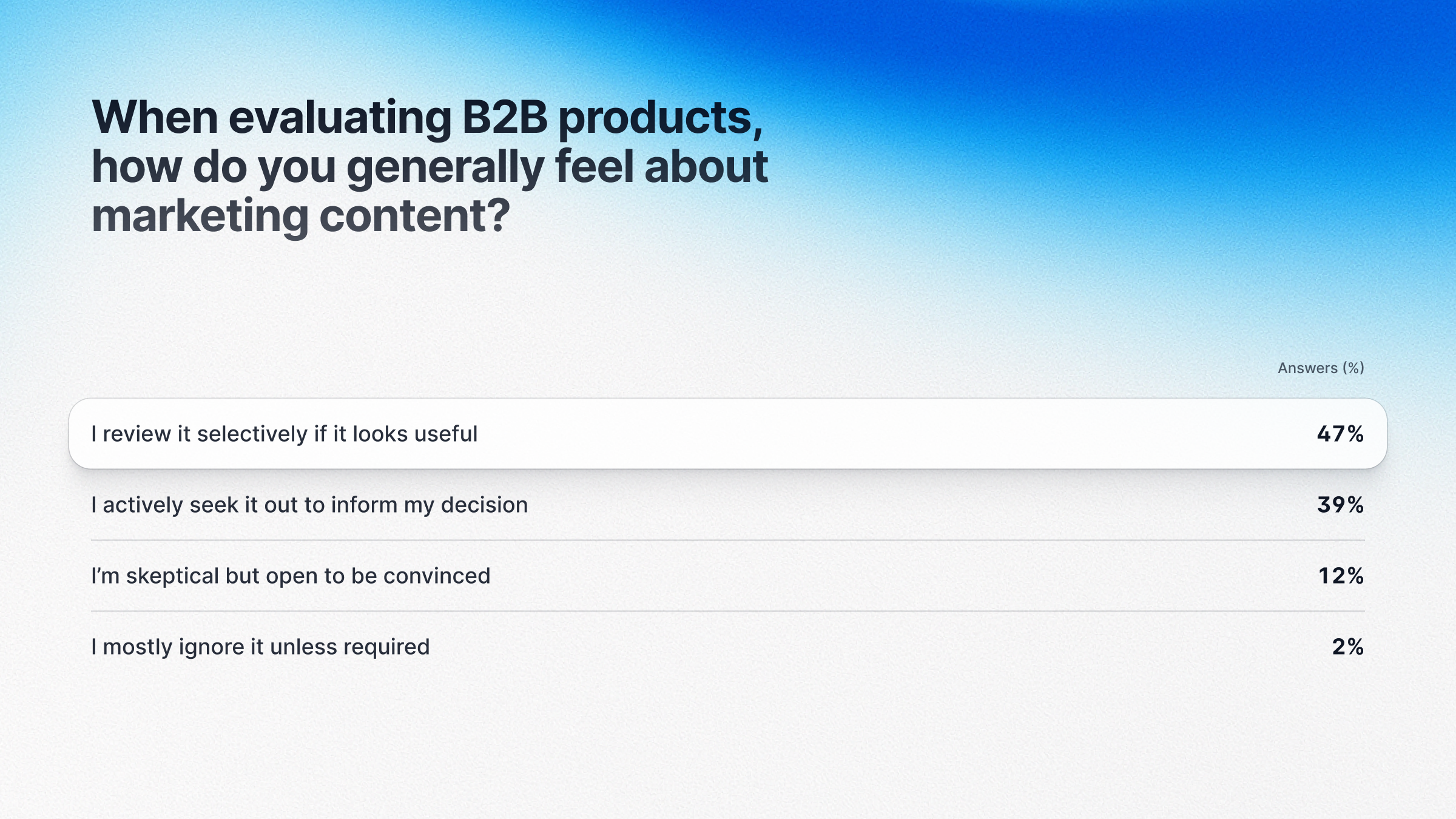
The reality is more nuanced. Yes, buyers are selective – but they're not closed off:
- 39% actively seek it out to inform their decision
- 47% review it selectively if it looks useful
- 12% are skeptical but open to being convinced
- Only 2% mostly ignore it unless required
In other words: 86% of buyers will engage with your marketing content if it's useful. The question is: what makes it useful?
What "Useful" Actually Means
Buyers aren't looking for perfection. They're looking for substance. Here's what makes marketing content genuinely useful:
- Clear explanations of how the product works in practice. Not feature lists – workflows. Not capabilities – use cases. Show me exactly how this works for someone like me.
- Specific examples tied to real use cases. Generic value propositions like "boost efficiency" or "drive down costs" are noise. Specific outcomes like "reduce time spent on manual data entry from 10 hours/week to 2 hours/week" are signal.
- Transparent discussion of tradeoffs or limitations. Nothing kills credibility faster than pretending your product is perfect for everyone. Buyers trust vendors who are honest about what their product does well and what it doesn't.
- Data and benchmarks buyers can use internally. The 47% who worry about personal credibility need ammunition to defend their decision. Give them ROI calculators, industry benchmarks, and data they can present to stakeholders.
The Enterprise Factor
Among buyers purchasing software at $12,000+/year, the appetite for vendor content is even stronger: over half (54%) actively seek it out to inform their decision.
This makes sense. Higher-stakes purchases require more due diligence. Enterprise buyers need to build a case for stakeholders. They need content they can share internally, data they can reference in business cases, and proof points they can use to defend their decision.
For enterprise vendors, this is an opportunity: buyers at your price point want your content. The question is whether you're giving them content worth consuming.
Implications for B2B GTM
- Prioritize usefulness over polish: A 15-page competitive comparison guide with real data is more valuable than a beautifully designed one-pager with vague claims. Focus on substance.
- Be honest about limitations: Acknowledging what your product doesn't do well (or who it's not right for) builds trust. It also helps you avoid bad-fit customers who'll churn anyway.
- Make content shareable: Your buyers need to build internal buy-in. Create content they can forward to colleagues, present to leadership, or reference in business cases. Think: one-pagers, ROI calculators, comparison guides, implementation timelines.
- Stop gating everything: If 86% of buyers will engage with useful content, why make them fill out a form first? Gating valuable content signals you care more about lead capture than helping buyers make informed decisions.
What Now? Putting It All Together
The data from 600 B2B software buyers tells a consistent story: buyers are looking for substance, empathy, and proof—not marketing theater.
Here's what that means in practice:
- Match your content to your segment, but never sacrifice substance. Lower-price buyers prefer candid authenticity; enterprise buyers need professional polish. But across all segments, jargon, buzzwords, and vague claims fail universally.
- Give buyers hands-on access earlier. 25% want immediate access to try your product. Every gate you put between buyers and hands-on experience costs you deals. Make self-service exploration useful and frictionless.
- Prove you understand before you pitch solutions. 48% say feeling understood by the vendor is the #1 factor in their decision. Only 7% claim purely rational decisions. B2B buying is deeply human—buyers worry about personal credibility, team fit, and vendor partnership.
- Create content buyers can actually use. 86% will engage with vendor content if it's useful. That means: workflows over feature lists, specific outcomes over vague promises, honest tradeoffs over perfection claims, and shareable data over gated downloads.
The Bottom Line
In 2026, B2B buyers are savvy, skeptical, and short on time. They've learned to tune out generic marketing speak, and they're looking for vendors who respect their intelligence.
The winning formula isn't more product differentiation – it's more authenticity in your storytelling, specificity in your messaging, and trust in your buyers to vet their options and make their own informed decisions.
Share on