Building on our recent deep-dive into the importance of building tension, we’re capping off our January storytelling series with another critical element that separates compelling narratives from the bleh ones. You can master pacing, structure, emotional stakes, and vivid imagery – but without this one ingredient, your story.. isn’t really a story.
The essential ingredient? Your hero.
Great storytellers center on a well-defined hero because it’s what makes the material relatable. It reflects the human experience by showing us as the audience someone who’s facing specific challenges, and that creates emotional investment. Abstract concepts don't have that same impact.
Similarly in product marketing, demos that speak to a specific buyer persona and their specific challenges – not your company, not an undefined “all-our-ICPs-in-one” stand-in – help get the core message across with emotional resonance. When your product story has a real hero at its center, buyers see themselves in that journey. When it doesn't, they see a feature list.
The universal framework that's been working for thousands of years
In 1949, mythologist Joseph Campbell published The Hero with a Thousand Faces and changed how we understand storytelling forever. Campbell identified what he called the "monomyth" – a universal pattern found across every culture and time period.
Campbell’s framework follows a simple but powerful structure: the hero ventures forth from the ordinary world into a region of challenge and wonder, faces trials and tribulations, achieves a decisive victory, and returns home transformed with the power to help others.
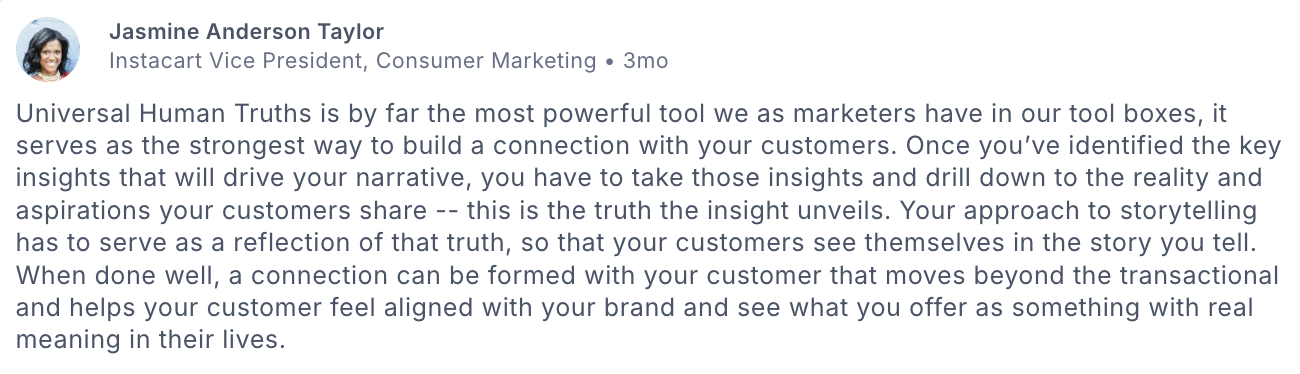
Campbell's observation of a pattern that had existed for millennia, from ancient myths to religious texts to oral traditions, reflects the Hero's Journey as a metaphor for life itself. We all face challenges, experience transformation, and (hopefully) emerge wiser on the other side.
George Lucas famously credited Campbell's work as the structural foundation for Star Wars, and the Harry Potter series clearly follows the Hero’s Journey. There’s no doubt this journey arc stands the test of time because it resonates.
But the Hero's Journey isn't just a plot device. It's hardwired into how we process and understand the world. We're biologically predisposed to recognize this pattern and respond to it emotionally.
This ancient framework isn't just academic – it's the foundation of how the most successful stories work today.
What popular culture teaches us about hero-making
Instead of digging straight into the GTM angle, let's first look at how two classic films demonstrate this principle perfectly:
Rocky (Academy Award Best Picture Winner, 1977)
Sylvester Stallone's breakthrough role as Rocky Balboa won Best Picture against powerhouse competition. The film could have been about boxing – the sport, the spectacle, the championship fight. Instead, it's about a small-time boxer from Philadelphia who gets one improbable shot at proving he's "not just another bum from the neighborhood."
The genius of Rocky is that it's never really about winning the fight. It's about Rocky proving his worth to himself, to Adrian, to the world. Here's the key lesson: Rocky loses the fight. Apollo Creed wins on a split decision. But that doesn't matter because the story was never about the destination – it was about the hero's journey and transformation. Rocky achieved what he needed: self-respect and proof that he could go the distance.
Forrest Gump (Academy Award Best Picture Winner, 1995)
Tom Hanks earned his second Oscar for playing Forrest Gump, and the film swept six Academy Awards including Best Picture. On paper, Forrest Gump is an epic –spanning decades of American history, from the Vietnam War to Watergate to the AIDS crisis. But despite the epic scope, the story remains intimately focused on one man's journey.
The film could have been about history. Instead, every major historical moment is filtered through Forrest's personal relationships. Vietnam matters because Bubba dies. The running craze matters because Forrest is dealing with heartbreak over Jenny. The key lesson: even when telling big stories that span vast timelines and major events, anchor everything to your hero's emotional journey. That's what makes it relatable and memorable.
Neither of these films won because of their production value or epic scope alone. They won because audiences saw themselves – their struggles, their hopes, their humanity – reflected in specific heroes navigating specific challenges.
How consumer brands make customers the hero
Notice what these two films didn't do: Rocky didn't spotlight the boxing ring as the star. Forrest Gump didn't make American history the protagonist. The environments, the contexts, the "tools" were all supporting players to the hero's journey.
The same principle applies to product storytelling. Your product is the boxing ring, the historical backdrop, or the lightsaber – it's the tool that enables the hero's transformation. The person who traverses the arc of the Hero’s Journey – Rocky, Forrest, Luke Skywalker, Harry Potter – is the hero. The same is true of your customer versus your product. When you flip this dynamic and make your product the star, you're telling a story about a boxing ring instead of a boxer. And nobody roots for a boxing ring.
B2C companies have long understood that products aren't the hero – the customer is. The most successful consumer brands position themselves as the guide in their customer's journey, not the star of the story.
Nike: "Just Do It"
Nike doesn't just sell shoes, they sell the journey of overcoming personal challenges. The hero in every Nike campaign isn't a professional athlete (though, they definitely feature many of them) – it's the everyday person trying to push past their limits.
"Just Do It" is brilliant because it's a call to action for the hero inside everyone. Not "Buy our shoes." Not "We make great products for active people." Just: you're capable of more than you think.
Their campaigns consistently feature diverse athletes overcoming obstacles – injuries, self-doubt, physical limitations. In fact, Nike Run Club doesn't promote shoes at all, it builds community around a shared interest in physical activity and transformation.
Key lesson: Nike positions their products as the tools that empower their customer’s personal “hero journey”, not as the hero itself in their stories.

Apple: The User as Creative Hero
Apple's marketing has always focused on what you will create, not what they built. The "Think Different" campaign didn't showcase Apple's engineering prowess – it positioned users as visionaries and rebels who would change the world.
Watch any iPhone commercial. They don't talk about processor speed or camera megapixels. They show you what you'll accomplish: the photos you'll take, the movies you'll shoot, the art you'll create, the memories you'll preserve. The iPhone is portrayed as the tool that empowers the creative hero inside you.
The hero's journey structure is clear: ordinary world (you have creative potential), catalyst (iPhone as tool), transformation (you become the filmmaker, photographer, artist you were meant to be). Apple is Obi-Wan handing you a lightsaber, not Luke Skywalker saving the galaxy.
Key lesson: Apple doesn't talk about what they built – they keep the focus on what you can accomplish.

Airbnb: "Belong Anywhere"
Airbnb isn't about booking accommodations – it's about the journey of feeling at home in unfamiliar places. The hero is the traveler seeking authentic connection in unfamiliar places. User stories sit at the center of every campaign, with hosts and guests as heroes in parallel journeys.
Their marketing consistently shows real people experiencing real places through the eyes of locals. The platform itself barely appears. What matters is the hero's transformation: from tourist to temporary local, from stranger to welcomed guest.
Key lesson: The platform is the guide that enables the hero's journey; travelers and hosts are the heroes.
The common thread across all these B2C brands: they understand that people don't buy products – they buy better versions of themselves. The product is the guide (Obi-Wan, Yoda, Gandalf). The customer is the hero (Luke, Rey, Frodo).

The same principle transforms B2B storytelling
The opportunity is exactly the same for B2B marketers as it is for B2C: Make your buyer the hero, not your product. The most successful B2B companies understand this implicitly.
Here's a cardinal rule for B2B storytelling: Your hero is always your prospective customer, your company is their guide, and the villain is the problem they're trying to solve.
Salesforce: The Sales Manager Under Pressure
Salesforce doesn't market "CRM software." They tell stories about sales managers trying to hit quota, marketers trying to prove ROI, and service teams trying to delight customers. The hero is always the person using Salesforce to achieve their goals, not Salesforce itself.
Their "Customer 360" positioning isn't about Salesforce's capabilities – it's about empowering sales heroes to see the full customer picture. Case studies follow the Hero's Journey structure: challenge faced, Salesforce as guide, transformation achieved, results celebrated.
Key lesson: Features serve the hero's transformation. The focus is always on what the customer achieved, not what Salesforce built.
HubSpot: The Marketer Learning Their Craft
HubSpot Academy doesn't exist to promote HubSpot's products, it exists to train their “heroes” – the marketers trying to grow their skills, prove they can bring more value to the businesses they work for, and advance their careers. HubSpot positions itself as the wise guide teaching the hero their craft.
The "Inbound" methodology is a framework for the hero's journey from traditional marketing to modern, customer-centric approaches. Educational content consistently focuses on helping users become better at their jobs, with HubSpot as the enabler.
Key lesson: Teaching your hero how to be better or more impactful at their job makes you the trusted guide. HubSpot wins by making their customers successful, not by promoting features.
Asana: The Project Manager Finding Clarity
Asana doesn't sell project management software – they tell stories about teams drowning in scattered updates and status meetings, and the project managers trying to bring order to chaos. Their marketing consistently centers on the overwhelmed PM who needs visibility, the team lead struggling to keep everyone aligned, the individual contributor buried in follow-up emails.
Their "Work Graph" positioning gives heroes clarity on who's doing what by when. Case studies follow the Hero's Journey: team struggling with coordination (ordinary world), adopting Asana (meeting the guide), achieving seamless collaboration (transformation), and reclaiming time for strategic work (return with newfound power).
Key lesson: Asana wins by solving for the hero's pain (chaos, lack of clarity, and wasted time), not by promoting their feature set. The focus is always on the team's transformation.
The mistake most B2B marketing makes is talking about "our platform does X, Y, Z" – which tries to make the product the hero. The result is a lack of emotional investment.
Buyers might intellectually acknowledge they have a problem, but they don't empathize with the product. And if they don't feel their own experience reflected through a relatable hero's journey, they won't prioritize solving it.
The framework: Making your buyer the hero
Here's how to structure your product story with the customer as the hero. Follow these five steps to transform your messaging from feature-focused to hero-centered.
1. Define Your Hero with Specificity
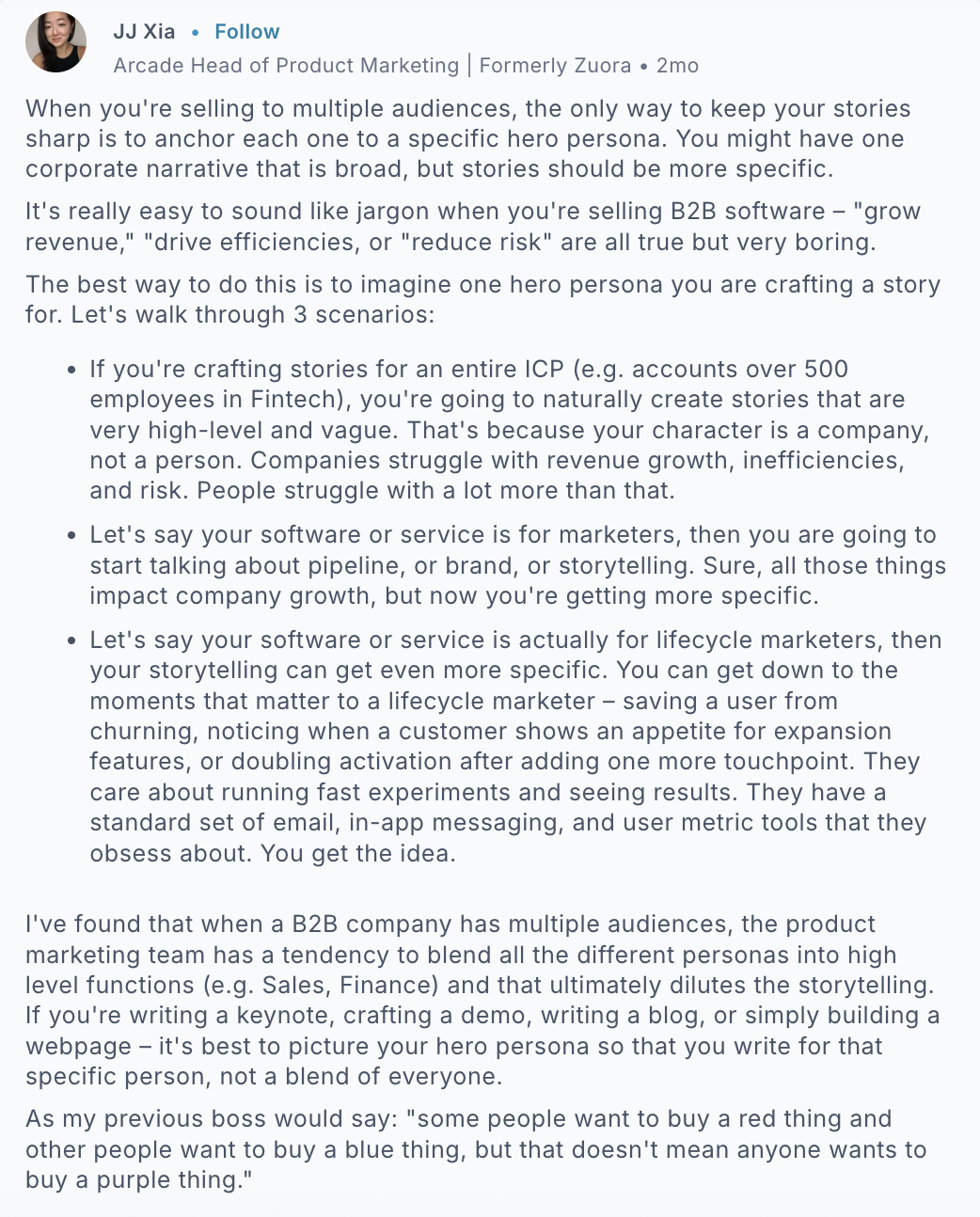
Instead of "Enterprise companies", tell the story of "Sarah, the VP of Sales who's missing quota because her team spends 15 hours a week on admin work instead of selling."
Give your hero a name and title, and identify their specific pain points instead of speaking to abstract problems. Understand both their personal and professional stakes, and be sure to use "you" language to put your buyer directly in the narrative.
Exercise: Write down: "Our hero is _____ [specific role] who is struggling with _____ [specific problem] which costs them _____ [specific impact]."
2. Identify the Villain (The Problem, Not Your Competitor)
The villain isn't your competitor – it's the obstacle standing between your hero and their goal.
A few examples:
- Instead of "our competitor's product", it’s "the chaos of scattered communication tools"
- Instead of "outdated systems”, it’s "the exhausting cognitive load of context-switching"
- Instead of "a lack of visibility", it’s "the anxiety of not knowing what's actually happening on sales calls"
The “villain” should be specific and observable, something your hero lives with daily, and deeply relatable so your audience thinks "yes, that's exactly what I face."
3. Position Your Product as the Guide, Not the Hero
Remember these critical distinctions:
- Hero: Your customer trying to achieve their goal
- Guide: Your product/company helping them get there
- Villain: The problem they're overcoming
The guide's role is to provide wisdom and tools (Yoda gives Luke the lightsaber), empower the hero to succeed (not do the work for them), believe in the hero's ability to transform, and show the path while letting the hero walk it.
In your demo: "Here's how [hero's name] overcame [specific villain] to achieve [specific goal]" NOT "Here's what our product does."
4. Show the Hero's Journey Arc
Structure your product story in three acts:
- Act 1 - Ordinary World (The Before): Where is your hero today? What pain do they live with? What have they tried that hasn't worked? Make this specific and visceral. Don't say "communication was inefficient." Say "After eight Slack threads and six revised decks, no one knew which version was final."
- Act 2 - The Quest (The Transformation): The hero encounters your solution (the guide) and begins their transformation. Show the specific moments of change. Not "our platform improved efficiency" but "Sarah's team got 15 hours back per week—time they now spend closing deals instead of updating spreadsheets."
- Act 3 - Return with the Elixir (The After): The hero achieves their goal. Show the specific, measurable victory and go beyond rational benefits to emotional ones. "Sarah hit 120% of quota AND left work at 5 p.m. for her daughter's soccer games." The transformation is both professional and personal.
5. Keep Your Hero Consistent Throughout
Across every touchpoint, maintain focus on the hero:
- Website: Lead with the hero's journey on your homepage—show the customer's challenges, transformation, and success. Not a list of features and capabilities, but a story prospects can see themselves in.
- Case studies: Focus on customer heroes achieving their goals and the obstacles they overcame. Highlight the transformation and results they achieved, not a catalog of your product's capabilities.
- Product demos: Walk prospects through the hero's transformation from struggle to success. Show how the customer navigates their specific challenges using your product as their guide, not a feature-by-feature walkthrough.
- Sales call decks: Start with "How are you feeling about [hero's challenge]?" and center the conversation on their pain points, goals, and desired outcomes – making them the protagonist of the discussion.
- Marketing emails: Lead with "Here's how [hero name] solved [problem]" and tell customer success stories. Show real people overcoming real challenges, with your product enabling their journey to victory.
- Videos and images: Show the hero's journey through your product – their workflow, wins, and "aha" moments. Instead of static screenshots, show the customer's path to success with your product as the guide.
People don't buy products for the products’ sake – they buy products that help them see better versions of themselves. Your job is to show them their transformed self, and position your solution as what gets them there.
The hero IS the story
Without a hero, tension doesn’t resonate. Features have no context. Benefits have no emotional weight.
Hero-first storytelling works because:
- Relatability: Specific heroes let buyers see themselves in the story. "Enterprise companies" is abstract. "Sarah, the overwhelmed sales VP" is someone they recognize.
- Emotional connection: We're wired to root for characters like us. Campbell identified this pattern because it's hardwired into human psychology. When we see ourselves in the hero, we emotionally invest in their success.
- Memorability: Stories with heroes stick; feature lists don't. Three months after your demo, buyers won't remember your features. But they'll remember Sarah's transformation from overwhelmed to empowered.
- Trust building: Positioning as guide (not hero) builds credibility. When you make yourself the hero, you're bragging. When you make your customer the hero, you're empowering. One feels like a sales pitch; the other feels like partnership.
- Decision catalyst: Heroes overcoming challenges inspire action. Buyers don't just intellectually understand they have a problem—they feel the urgency to change when they see themselves in the hero's struggle.
What happens when you get it wrong: Generic "solutions for enterprises" messaging falls flat. Feature-first demos feel transactional. Buyers can't visualize themselves succeeding. No emotional stake equals no urgency to change. They might say "interesting" and never follow up.
What happens when you get it right: Buyers think "that's me – they understand my world." Demos become relatable journeys, not product walkthroughs. Sales conversations focus on the buyer's transformation, not your features. Higher conversion, stronger loyalty, and organic advocacy follow naturally.
Your product story needs a hero because that's how human beings are wired to understand the world. From ancient myths to Oscar-winning films to billion-dollar brands – the pattern is universal. Make your customer the hero, position yourself as their guide, and show them the path to transformation.
Give them the lightsaber, teach them the Force, and watch them save their own galaxy.
Share on