If you’re evaluating Storylane as a product demo software, pricing is probably one of the hardest parts to unpack.
Storylane’s plans scale quickly, include multiple add-ons, and unlock very different capabilities depending on the tier, making it tough to understand what you actually get for the price, and whether it’s worth it for your team.
In this guide, we break down Storylane’s pricing structure, plans, and add-ons, explain how costs grow as you scale, and highlight where teams tend to feel the tradeoffs.
At the end of this guide, we’ll introduce a new interactive demo software that can help you create product demos quicker and easier than Storylane.
Storylane is an interactive demo platform that lets you quickly create product demos and tours. The tool has a free plan as well as four paid plans.
➡️ Storylane’s pricing model is that you pay a monthly or annual plan (20% discount) depending on the features you need, and then pay extra if you require extra seats.
Here's a little sneak peek into Storylane’s pricing:
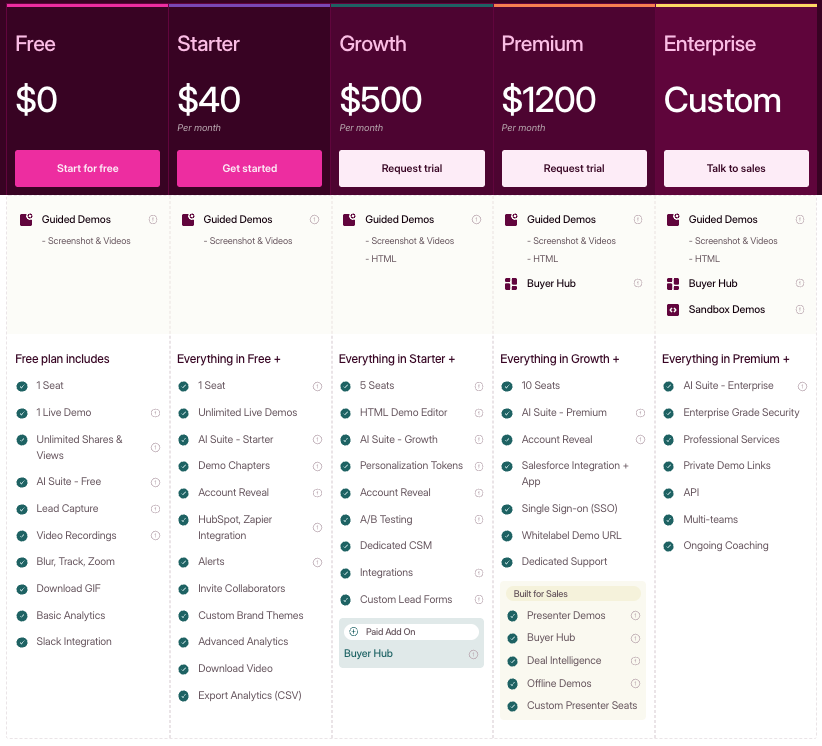
You can start for free with the tool and then upgrade to the tool's monthly or annual plans.
➡️ The pricing structures are not influenced by the volume of visitors watching your demos, as some Storylane competitors do.
Yes, Storylane has a free version of its interactive demo building software. You can publish one live guided demo to test the waters with one seat available.
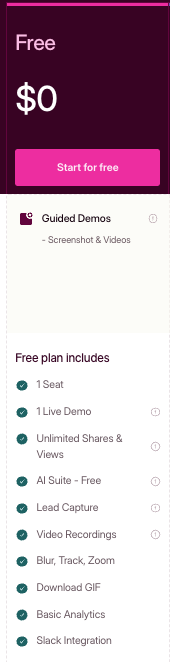
❗On the Free plan, you must build the interactive demo with screenshots and videos only. With the paid plans, you will be able to make guided demos using HTML as well.
The free plan includes:
It is not as easy to get started on Storylane as other alternatives.
According to one verified user, the platform has a steep learning curve, and it takes time to get accustomed to it.
“The UX for creating steps in demos can take some time to get used to. Sometimes, there are more clicks than necessary to get something done. If you like to get fancy with the positioning/format/display of customer directions in a demo, things can get a bit buggy to get just right.”
With Storylane’s Starter plan, you will get access to create unlimited live guided demos using screenshots and videos.
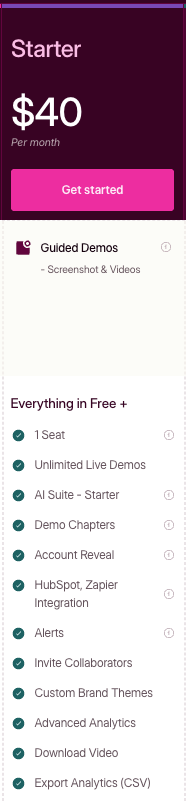
Starting from $40/month, when paid annually, you will get all of the features in Free, plus:
For each additional seat, it's $40 per user on the Starter plan.
Users of Storylane note that the platform’s customization features are limited.
While researching the platform, we found that inside Storylane, you can’t add brand-specific features, such as a custom loader and modal designs.
Customization and personalization are important in 2026, as brands want their interactive demos to resemble their products and websites.
“Customization features are limited, i.e., arrows or back buttons, but they work.”
Storylane’s Growth plan starts at $500/month and gives you access to unlimited live demos using screenshots, videos, and HTML.
This tier is ideal for brands that want to clone their product with HTML capture.
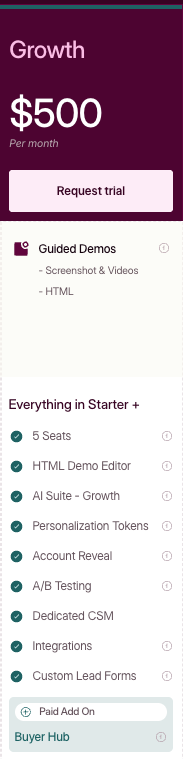
With the Growth Plan, you will get all the features in Starter, plus:
Your brand will also get access to a dedicated customer success manager who will help you resolve issues faster.
There are also two additional paid add-ons that you can select:
Even though customers consider the product great, they confirm that creating a demo isn’t necessarily quick and easy.
“The product is great, but creating a demo can be a little time-consuming.”
Storylane’s Premium plan gives you access to 10 seats as well as the Buyer Hub.
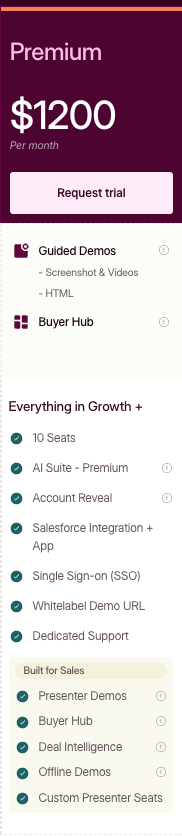
Costing $1,200 per month when paid annually, you will get access to all of the features in Growth, plus:
Your brand will also have access to a dedicated client support manager.
💡 Start-up discount: For early-stage companies that are bootstrapped, seed, or pre-seed stage, Storylane offers a discount on the "Growth" and "Premium" plans.
Despite Storylane’s wealth of features, creating mobile-friendly interactive demos is impossible.
This has been a deal-breaker for product marketers who want to deliver interactive demos that don’t only look great on desktop.
“The Storylane tool is not mobile friendly, but I'm sure they're working on this as I write this review.”
Storylane’s Enterprise plan gives you access to Sandbox Demos as well as even more customization options, professional services, and increased security.
The plan is perfect for large organizations that want to train their team to build interactive demos effectively and gain access to the tool’s API.
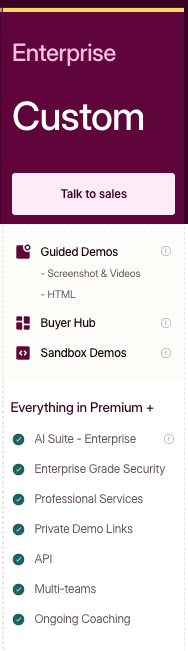
The Enterprise plan has custom pricing, which gets you access to all of the features in Premium, Sandbox Demos, and:
A verified enterprise user of Storylane describes the tool’s enterprise pricing as something to think about.
“Price is a bit tough to swallow, will wait on the ROI to justify its price.”
According to Vendr, the median annual price for Storylane is $11,500, but it can go up to $31,325.
Disclaimer: The sources are anonymous, and we could not verify these numbers.
If you are unsure if Storylane’s pricing is right for your team’s needs, you can consider alternatives to Storylane.
If your primary focus is creating compelling product demos to impress and captivate your audience without costing tens of thousands of dollars, look no further than Arcade (our tool).
💡 You can also check out our detailed comparison between Storylane, Navattic, and Arcade.
Our customers love Arcade’s versatile options for building demos, packed in an intuitive, easy-to-use interface.
You can use Arcade’s Chrome extension to:
Additionally, Arcade has a desktop app to record:
💡Your team won’t have to use separate tools for screen recording, screenshots, creating, and editing interactive demos. You can do it all from Arcade.
The software also lets you upload existing videos and screenshots as pillars for your interactive product tour.
The platform then stitches the videos and screenshots into demo steps.

💡Pro tip: This method of creating interactive product demos is a particularly flexible option if you want to make demos for mobile applications or migrate existing demo content.
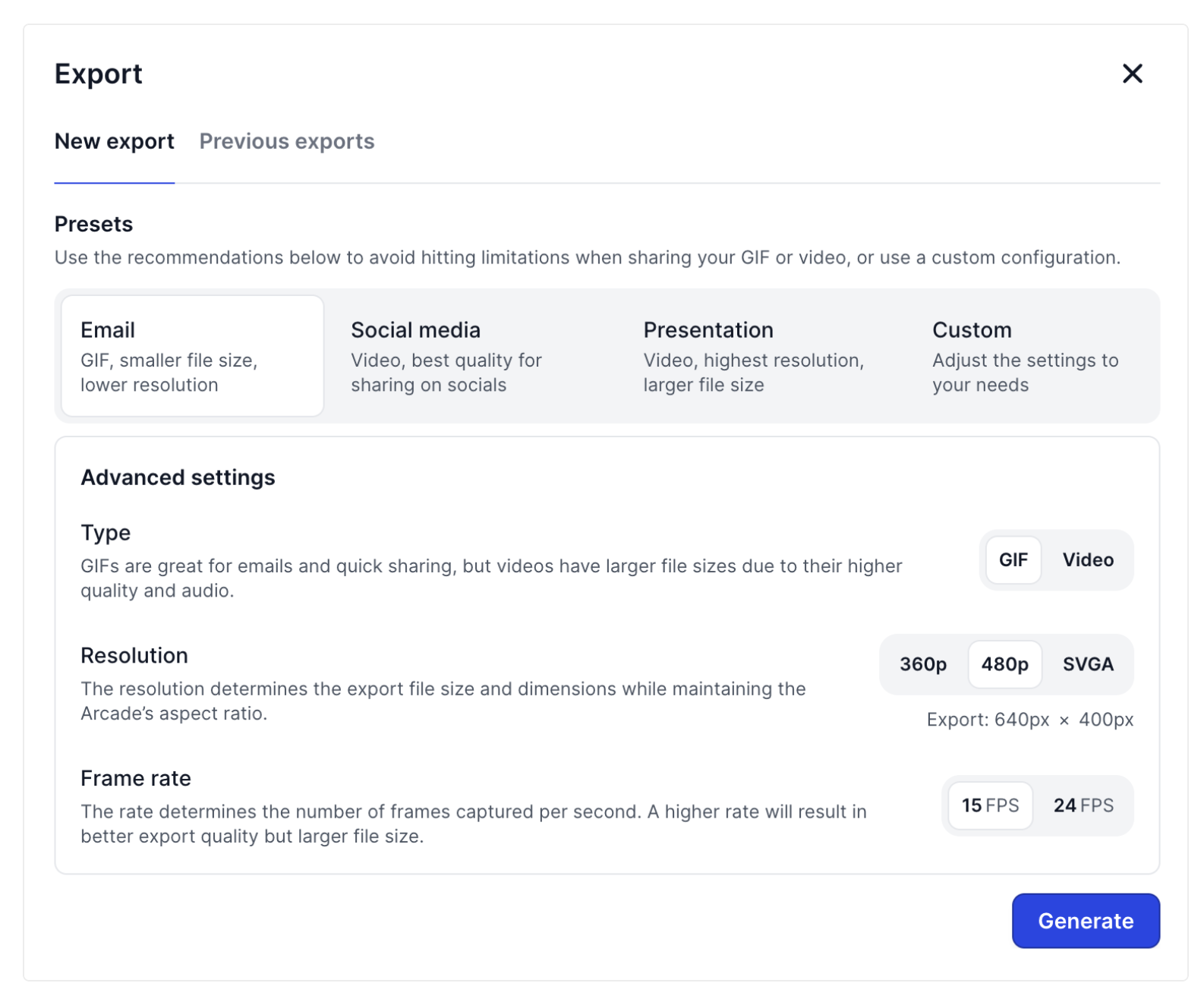
When your interactive demos are ready, Arcade supports multi-media and multi-channel exports, such as:
And to put the cherry on top, Arcade’s demos are mobile-friendly (unlike Storylane’s).
The tool’s demos are optimized for mobile phones, meaning they are automatically adjusted to the device they’re viewed on.
Once a product flow is captured, Arcade Creator Studio lets teams reuse that same recording across multiple formats without rebuilding or re-recording the flow.
From a single capture, teams can create:
Arcade is especially useful for teams that need to ship product content quickly across channels without maintaining separate tools or duplicated workflows.
Arcade helps you tell your product story the way you want to by providing advanced editing options, such as:
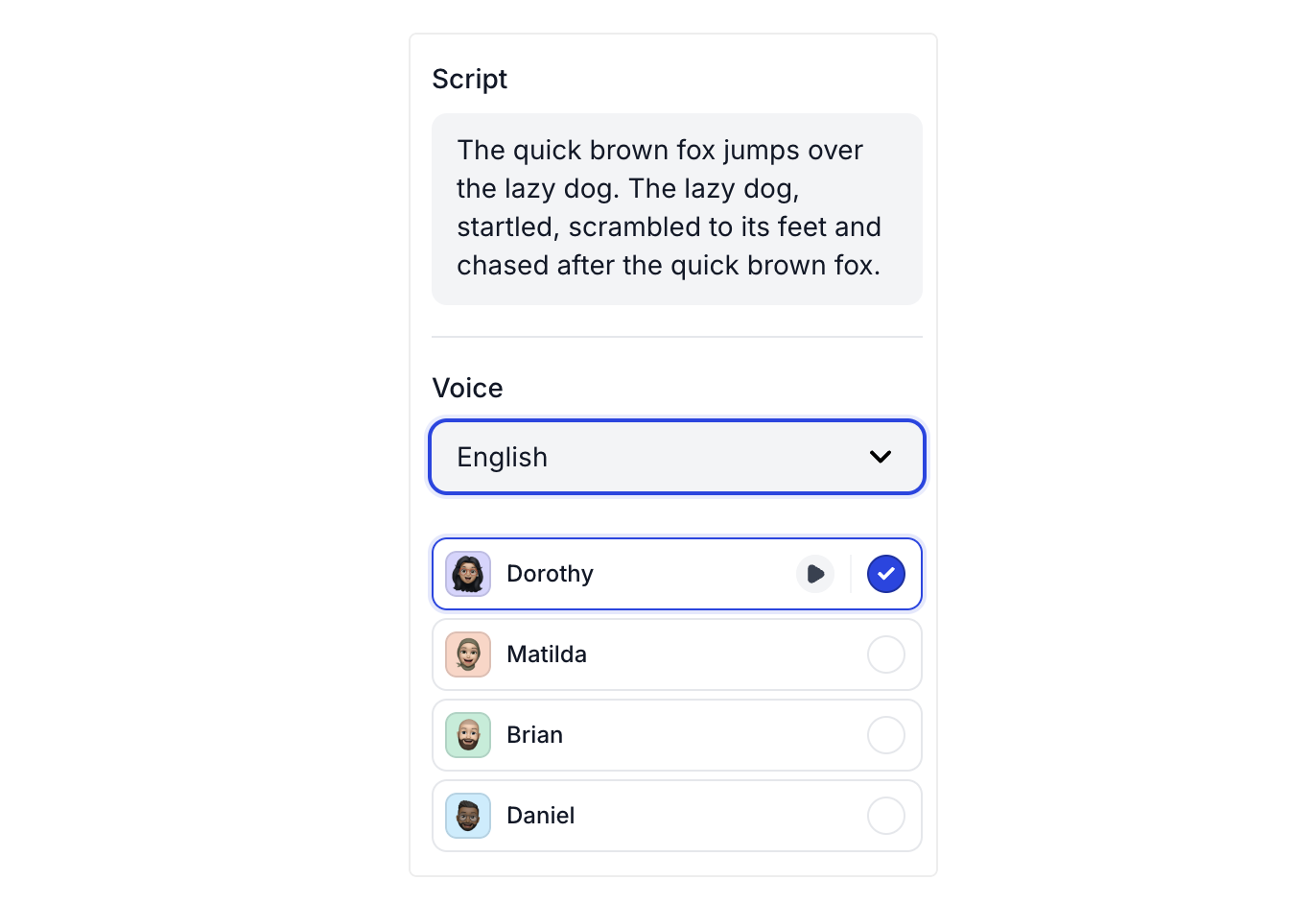
Arcade includes brand-aware AI that automatically applies your visual identity across demos, videos, and visuals.
Using its built-in Brand Kit, Arcade analyzes your website and existing content to capture:
That context is then applied automatically as you create or edit content, so changes like updating copy, adding a step, or exporting a new asset don’t require a designer to re-style or clean things up afterward.
Teams can maintain consistent, on-brand output even as demos are reused, personalized, or updated over time.
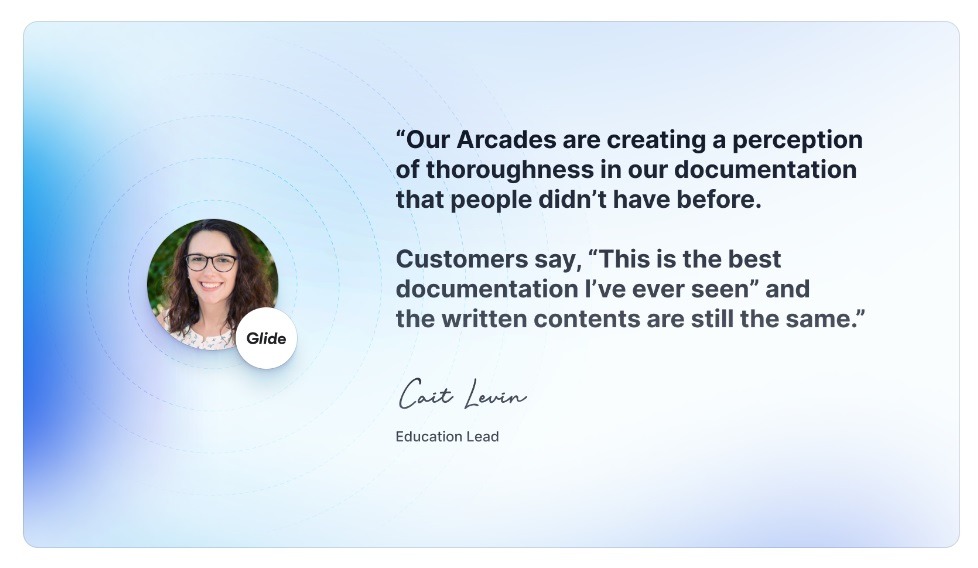
Case Study: Glide saved six months of content production.
Glide was able to refresh and expand two-thirds of its documentation, reducing the production time for six months' worth of content (video).
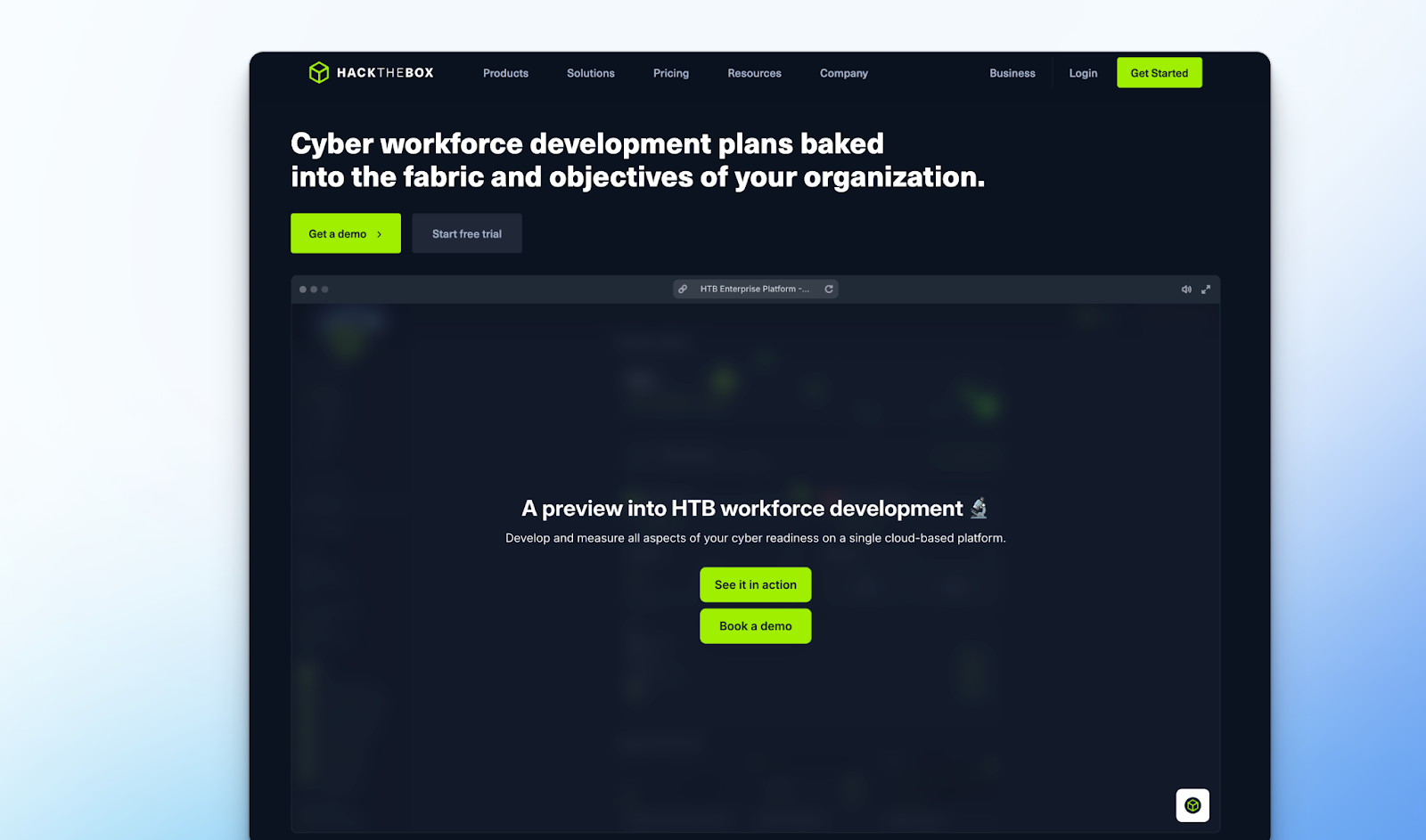
Brands care about creating interactive demos that seamlessly fit their brand, such as HackTheBox. 👇
Personalization is the key to success in today’s competitive market, and it also applies to product demos.
This is why crafting a customized demo for each lead will make your brand more memorable.
You can create fully personalized demos quickly with Arcade’s custom variables and links.
➡️ Variables are placeholders you can define that turn specific text within your product demo into templates.
When viewed, these templates will be replaced with personalized values, such as the lead’s first name, company name, etc.
Test it out here. 👇
➡️ You can also personalize demos for many viewers with custom links.
The tool will automatically generate a template with dynamic placeholders and lead data.
➡️ Page Morph helps you personalize demos for specific prospects by directly editing the text of your recording product.
Creating a demo is only part of the workflow. Arcade also helps teams understand who’s engaging and how demos perform.
Built-in capabilities include:
These insights help product, marketing, and sales teams connect demo engagement directly to pipeline and revenue activity.
Arcade’s pricing is primarily based on the number of demos you require.
Arcade also has a more generous freemium plan that lets you create and publish three interactive product demos (instead of one with Storylane), including camera recording, synthetic voiceover, and Avery AI (that automatically generates a title, chapters, and content for your demos, tailored to your specific needs).
For unlimited product demos and more design, personalization, and sharing options, you can subscribe to one of three paid plans:
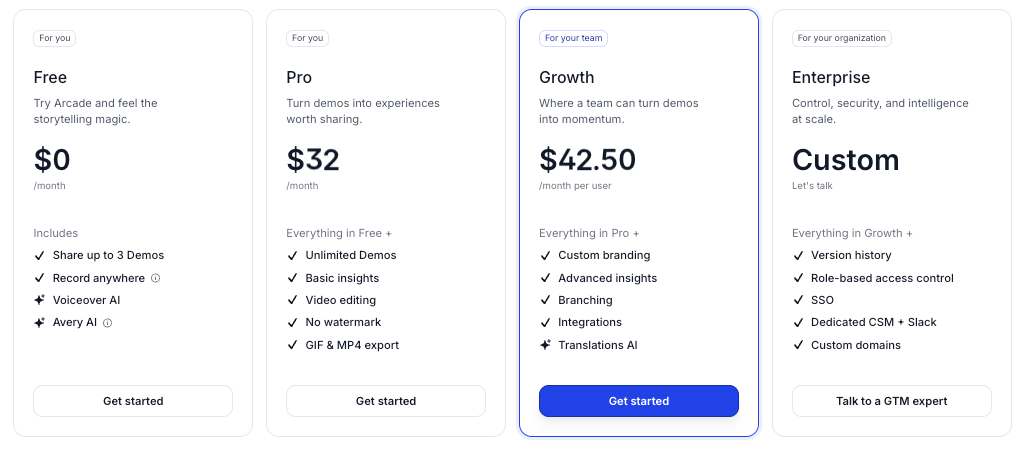
Note: You can try Arcade’s Growth plan’s advanced editing, branching, and collaboration features with its 14-day free trial. Try it for free to experience Arcade’s full capabilities.
Telling your product's story is challenging, and today's buyers expect you to show them your product, not just talk about it.
Arcade removes the creative and technical barriers felt by product marketers who want to showcase their products on a website, content, or social media.
The tool is right for your team if you’re looking for a product tour solution that is designed for ease of use and offers:
Whether you're launching a new feature or building a full demo library, Arcade helps you create studio-quality product content without waiting on designers or developers. Start creating with Arcade and see why GTM teams ship demos in minutes, not weeks.
In practice, it means less duplicated work. With Arcade Creator Studio, one product recording can power an interactive demo, a polished marketing video, website visuals, sales assets, and exportable GIFs or MP4s.
Teams don’t have to rebuild the same flow separately for each channel, which dramatically reduces production time as content needs grow.
Not at all; interactive demos are just the starting point. Arcade is built for broader product storytelling, using the same product capture to create demos, videos, website visuals, sales collateral, and campaign assets.
The goal is to let teams show their product everywhere without re-recording or re-editing the same flow in multiple tools.
Arcade is generally the better fit for fast-moving teams. Its auto-updating demos and reusable captures help keep content aligned with frequent UI changes, reducing the need to constantly rebuild demos from scratch.
HTML-heavy workflows typically require more manual maintenance as products evolve.
Storylane can be a good choice if your team specifically wants an HTML-based demo builder with deep post-capture control, or if you rely heavily on structured sales demos using Buyer Hub or Sandbox Demos.
It’s often better suited to teams that value granular control over speed and are comfortable with longer build cycles.
Arcade tends to win when speed, flexibility, and reuse matter most. It’s a strong fit for teams that want to record their real product, ship demos quickly, reuse content across channels, and keep everything on-brand without constant design cleanup.