By Nick Sorrentino, Head of Engineering at Arcade
I’ve worked closely with marketing teams at every company I’ve been part of, and one pattern keeps showing up: A lot of creative work feels way more stressful than it should because of bottlenecks.
At one of my previous roles, I remember being so frustrated with the brand design workflow because it would take months to create something that I could ship in fifteen minutes. But the bottleneck wasn’t the people – it was what they had to work with.
Today’s GTM teams don’t have a creativity problem, they have a systems problem.
Why Today’s Creative Workflows Feel So Rough
Most creative output systems are fragile by default. One small copy edit turns into a weeks-long feedback loop spinning Slack, email, and word of mouth, while a ticket requesting “quick design support” sits in a backlog for 12-14 business days because the team is buried under a mountain of other priorities.
Tools built for experts assume every user has the instinct to manage layout, hierarchy, spacing, tone, contrast, and clarity, but not everyone on the team is an expert, which leads to hesitation and roadblocks at every minor turn. When small edits feel risky, it’s a pretty clear sign that the system is not on your side.
AI came along promising to help, but today, most generative AI tools end up creating what’s now broadly called “AI slop.” You know it when you see it – visuals that look either too generic, slightly wonky, or just plain weird. Ask a model to brighten a background, and it might change your entire aspect ratio. Try fixing a single word on an image, and the whole composition regenerates. Here's an (exaggerated-for-emphasis) example:
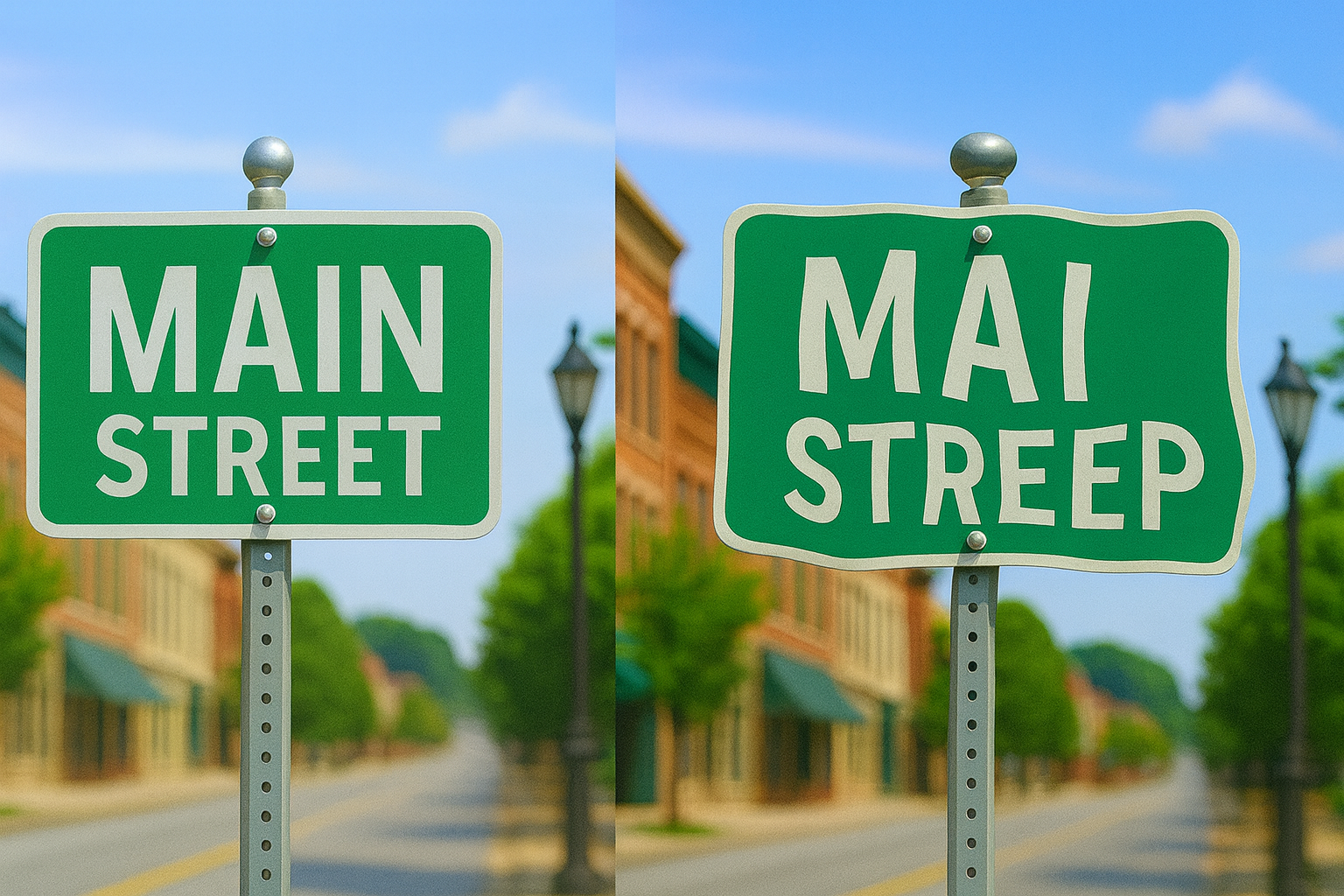
You see this especially with video content generation – if you want a hillside with wavy grass, great. But a beautiful, on-brand sizzle reel? Good luck. You’re more likely going to get all sorts of crazy artifacts popping up. Ask for the same three-second clip twice and you’ll often get completely different results - sometimes even with extra components that weren’t even in the original prompt.
Instead of speeding you up, AI forces you into a regenerate loop where you spend ten minutes trying to fix something that never should have broken in the first place. This is what I mean when I say GTM stress is a systems problem. AI didn’t fix the system, it just added more randomness. Workflows and AI may break the creative flow for different reasons, but they break it in the same way: tiny changes lead to disproportionate chaos.
Why Controls Matter More Than Flexibility
One of the biggest misconceptions about creative tools is that more flexibility equals more power. In reality, the opposite is usually true.
Open-ended tools make it easy to create almost anything, but they also make it incredibly easy to create something unusable. That might be fine for expert designers with years of training, but most GTM team members don’t operate in that world. They need systems that protect them from unpredictable outcomes.
At Arcade, we built controls that reduce the number of ways something can go wrong. These controls stabilize the workflow so people can move faster and second-guess less.
Here’s how we’re thinking about it:
- Fewer decisions: We eliminate unnecessary choice points so creators aren’t forced to think like designers or prompt engineers. The system handles spacing, arrangement, and safe defaults automatically, reducing hesitation and speeding up the path to a usable asset.
- Design rules that actually work: We teach the model foundational principles — things like contrast, whitespace, color ratios, and readability. Instead of vague style guidance, we provide our models with color theory references, rule-of-thirds examples, whitespace standards, and marketing layout patterns.
- Layout limits: We cap things like chapter counts, button quantity, and background complexity. These limits exist because we tested what happens when you remove them, and it always results in a cluttered mess.
- Controls that keep AI from producing nonsense: Instead of letting the model hallucinate visual content, we give it a structured sandbox. We also match each task to the model that statistically performs best: removing text uses a specialized editing model; generating layouts uses another; remixing color palettes uses a third. We validated this across hundreds of models using chi-squared tests, Fleiss Kappa scoring, and our internal model-evaluation tool, Tonal.
How do we get our generation models to behave in this way? We’re extremely selective with which LLMs we use for every task. Image generation alone breaks into multiple subtasks — text-to-image, editing, remixing — and not every model handles each equally well.
We tested them all, gathering feedback from hundreds of testers to refine the exact prompt-model pairings. Now, teams can move faster with less stress because the workflow is designed to protect them, not slow them down.
Why Layered Architecture Beats Fully Generative Anything
One of the biggest differences in how we’re building at Arcade is choosing not to rely solely on fully generative outputs.
Instead, we use the LLMs to generate instructions — the “script” — and then we use code to render the output. Fully generative assets are fragile, but code doesn’t hallucinate, reinterpret your layout, or decide to reinvent your brand elements. If you’ve ever tried regenerating an image or video because you didn’t like a punctuation mark, you know what I mean. Change a single comma, and you often get an entirely different visual output.
With a layered system, 1) structure and style are separated, 2) backgrounds, text, and motion all live independently, 3) changing one piece won’t break the entire thing, and 4) the render is predictable because it's code, not chaos.
That’s the difference between a bottleneck-proof system and a gamble.
What Better Systems Unlock: Faster Launches (and Lower Blood Pressure)
When the creative system finally stops fighting the team, everything else gets easier. The hesitation disappears, the back-and-forth slows down, and small edits stay, well, small.
Suddenly, the effort that used to go into wrestling with tools can finally go into shaping the story itself. And when the system just works, you get:
- Marketers who can actually self-serve. Not the fake “self-serve” that still requires dragging boxes around for two hours, but real autonomy with clean, on-brand outputs.
- Designers who get to work on high-leverage creative work Instead of focusing on emergency edits, broken assets, and ticket-queue triage, they can prioritize strategy and craft.
- Faster launches. Not because people are working harder, but because the workflow finally supports them.
- More experimentation. The team ships more often, learns more often, and stops treating every asset like a high-stakes event.
That’s what breaking the bottleneck from the inside out looks like. You rebuild the system so that the humans inside it can actually breathe.
Fix the Systems, Break the Bottleneck
If creative work feels stressful, it’s probably because your system is broken.
When you fix the workflow – by adding controls, reducing unpredictability, and making AI behave in ways humans can trust – the pressure drops almost instantly.Teams can finally operate at the speed modern GTM demands, without the drama and stress that typically comes with it.
This has never been a creativity problem. It’s a systems problem – and once you fix the systems, the creative output bottlenecks tend to disappear.
Share on