The enterprise sales cycle no longer starts with a salesperson pitching a static slide deck or a generic discovery call. In 2026, the primary driver of sales is the product experience itself.
What the buying committee actually cares about is operational efficiency, scalability, and security. In an era of "show, don't tell," the only way to convince them that your software checks those boxes is to let them experience it firsthand through a self-guided, interactive environment.
This playbook moves past simple screen recording to outline the strategic architecture of demo-led growth. We’ll cover what to look for in enterprise interactive demo software and assess the best options on the market.
Why interactive demo software matters for enterprise GTM teams
The main reason this software matters is simple: It lets your product sell itself when you aren't in the room. Instead of forcing a dozen or more internal stakeholders to wait for a gatekept meeting they likely won't attend, interactive product demos allow them to test drive the software on their own time. It turns your product into a shareable, asynchronous asset that technical leads, security officers, and procurement teams can verify whenever they have five minutes of headspace.
By putting a hands-on version of your product directly into the hands of the entire committee, you move from a slow, inefficient sales model to a high-velocity motion where the product provides the proof, and the analytics provide you with the roadmap to close.
What to look for in enterprise interactive demo software
Before comparing specific platforms, you need to evaluate them through the lens of scalability and security. In an enterprise environment, a tool that works for a 10-person startup will often fail when exposed to global security audits or 50 different brand managers.
These criteria ensure your demo strategy scales without creating technical or brand friction:
- Centralized brand control: Look for platforms that allow you to set global design themes, including fonts, colors, and button styles, across the entire organization. This ensures that every demo, regardless of which department created it, is aligned with your corporate identity and can be easily updated.
- Audience-specific customization: Your software should allow you to change the focus for different stakeholders, creating, for example, one version for a Technical Architect (focusing on APIs and security) and another for a VP of Sales (focusing on high-level dashboards and ROI metrics) from the same core capture.
- Advanced insights and pixel-level engagement: Move beyond basic view counts in favor of granular tracking that identifies exactly where viewers drop off and which specific parts of the screen capture the most interest. This "pixel-level" data creates a feedback loop, allowing GTM teams to optimize their story based on what actually drives committee consensus.
- Enterprise-grade security and compliance: Ensure the platform is SOC 2 Type II and/or GDPR compliant, with built-in tools to blur or redact sensitive Personally Identifiable Information (PII) during the capture process.
- Automated user governance: To maintain control at scale, prioritize tools that support Single Sign-On (SSO) and System for Cross-domain Identity Management (SCIM). This allows your IT team to automate user permissions through providers like Okta or Azure and immediately revoke access to the demo library during employee offboarding.
The best enterprise interactive demo software in 2026
Now let’s look at the best enterprise interactive demo software options so you can choose the one that best fits your organization’s needs.
Arcade

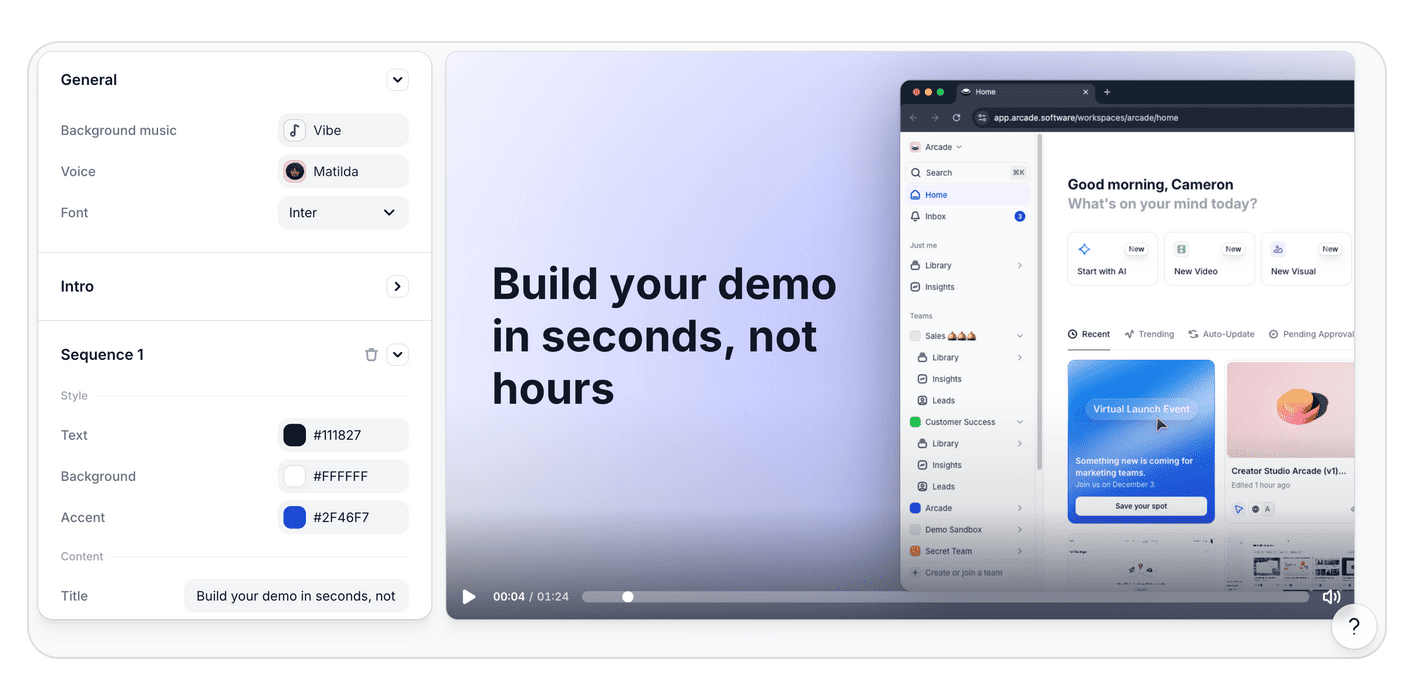
Arcade is built for the entire GTM lifecycle, serving as a unified product storytelling engine for marketing, sales, and customer success teams. The platform enables anyone to build polished, interactive stories in minutes while ensuring every asset remains aligned with corporate standards.
For enterprises, Arcade’s value lies in its "capture once, deploy everywhere" architecture. A single high-fidelity recording can span multiple software applications and create various assets for the entire customer journey. Enterprises have the confidence of a consistent, high-quality product story in the form of an embed on a high-traffic marketing site, a personalized link in a sales email, or an onboarding guide in a help center.
Key capabilities
- HTML & multi-app capture: Captures the underlying code for pixel-perfect clarity and easy text editing/blurring, allowing you to stitch together multiple applications into a single seamless story across platforms.
- AI context engine: Automatically generates voiceovers, copy, and localized translations in dozens of languages.
- Audience reveal: Identifies the specific companies engaging with your demos to provide high-intent sales signals.
- Enterprise governance: Includes SSO, SCIM, Role-Based Access Control (RBAC), and multiple brand kits for global teams.
Why do people pick Arcade?
- Supports multiple enterprise use cases, including pre-sales, marketing, customer support, onboarding, and engineering.
- The Chrome browser extension makes recordings and edits easy.
- A single recording can be turned into multiple marketing and sales assets for social media, email, and websites.
What are Arcade’s weaknesses?
- The learning curve for advanced features can be daunting for some users.
- Arcade doesn’t offer a traditional, interactive sandbox experience.
How much does it cost?
- Free: One published demo, one published video, basic recording tools, access to the Arcade MCP, and 200 AI credits per month.
- Growth ($42.50/mo per user): All Free features plus custom branding, advanced insights, advanced branching, translation AI, integrations, and more
- Enterprise (custom pricing): Growth features plus version history, custom domains, role-based control, SSO, and dedicated support on Slack
Interested in seeing how Arcade can help your GTM team create engaging, interactive enterprise demos? Contact our sales team to get started.
Storylane
Storylane is favored by sales engineering and product marketing teams who need a balance between high-speed capture and deep technical customization. Its workflows allow teams to gate demos with custom forms that sync directly with CRM data, accelerating the pipeline.
While it is user-friendly for creators, it also offers a "pro" layer of customization that appeals to technical teams who need to redact sensitive data or simulate complex product environments without involving engineering.
Key capabilities
- Dual capture engine: Supports both HTML-cloning and video-based captures for mobile or desktop apps.
- Lead capture and routing: Advanced native forms that integrate with tools like Marketo, HubSpot, and Salesforce to capture and route leads instantly.
- Collaboration workflow: Built-in commenting and approval cycles, allowing marketing and sales to collaborate on demo drafts.
Why do people pick Storylane?
- Some customers like its speed and ease of use.
- The support features, including documentation and AI, are helpful for many.
- Engagement tracking can help better target sales efforts.
What are Storylane’s weaknesses?
- The integration with HubSpot can be slow to load.
- Analytics could be more granular.
- Tours designed for desktop don’t always translate well to mobile.
How much does it cost?
- Free: 1 seat, 1 published demo, lead capture, video recordings, blur, track, and zoom
- Starter ($40/mo): 1 seat ($40 per additional seat), unlimited published demos, account reveal, HubSpot and Zapier integration, alerts, and advanced analytics
- Growth ($500/mo): 5 seats ($100 per additional seat), HTML demo editor, custom lead forms, and a dedicated CSM
- Premium ($1,200/mo): 10 seats, Salesforce integration and app, whitelabel demo URL, deal intelligence, and presenter demos
- Enterprise (Custom pricing): AI Suite - Enterprise, enterprise-grade security, private demo links, API, and ongoing coaching
Navattic
Navattic specializes in high-fidelity HTML cloning. Unlike tools that take a series of screenshots, Navattic’s browser extension captures the actual front-end code of your application. This means the resulting demo isn’t just a walkthrough but a functional replica where hover states, dropdown menus, and animations work exactly as they do in the live product.
Key capabilities
- Agent demos: AI agents can interact with users to understand their intent, interpret questions, and navigate the demo experience to show relevant features and functionality.
- Global asset management: Centralized libraries allow marketing teams to push updates to dozens of embedded tours simultaneously.
- Team workspace governance: The sophisticated permissioning systems allow you to create isolated workspaces for different global regions or product lines. Controls allow reps to build demos, but only authorized admins can hit "publish."
Why do people pick Navattic?
- The option to highlight specific features is beneficial to enterprises.
- Customer service and support are highly rated.
- Onboarding is easy and stress-free.
What are Navattic’s weaknesses?
- The click-through feature may not be conducive to some types of use.
- The tour-building experience often has slow load times.
How much does it cost?
- Starter (free): 1 seat and 1 published demo, unlimited views, and basic analytics
- Base ($500/mo): 5 seats and unlimited HTML demos, embedded forms, A/B testing, and personalization
- Growth ($1,000/mo): 10 seats and unlimited HTML demos, interest level and sandbox demos, advanced analytics, and demo translation
- Enterprise (custom pricing): Unlimited seats and unlimited HTML demos, offline demos, HTML capture translation, audit logs, custom permissions, and priority support
Walnut
Walnut excels at the post-discovery phase of the enterprise cycle, where sales teams need to provide a stable environment that looks and acts like a live product but is entirely controlled.
With its heavy focus on AI-driven personalization and insights, Walnut helps sales organizations identify exactly which stakeholders in a complex buying committee are engaging with the product, allowing for hyper-targeted follow-ups.
Key capabilities
- Digital sales room: Walnut offers a unified space where a rep can host multiple demos, documents, and stakeholders in one collaborative hub.
- InsightsAI: Advanced predictive analytics highlight which features are most likely to close a deal based on stakeholder engagement patterns.
- Multi-language localization: Supports 25+ languages, allowing global teams to localize entire demo experiences instantly.
Why do people pick Walnut?
- The ability to tailor for different personas or industries is valuable for sales teams.
- The content creation process feels intuitive.
- The no-code platform is easy for non-technical people to use.
What are Walnut’s weaknesses?
- Software updates to Walnut require clients to modify existing demos.
- Some customization options feel restrictive.
- Recording can be slow for heavy dynamic websites.
How much does it cost?
- Ignite ($750/mo): 3 editor seats, unlimited demos, demo analytics and engagement tracking, and marketing tool and CRM integrations
- Accelerate ($1,550/mo): 5 editor seats, 5 presenter seats, sandbox demos, prospect personalization, video overlays, and advanced Salesforce integration
- Scale (custom price): Custom seat limit, white-labeled brand experience, advanced translations, team analytics, and email and video support
Consensus
Consensus is an automated sales engineer, scaling the impact of high-value technical teams by handling repetitive, early-stage product overviews.
It excels in the sales stage between the first lead and the final technical deep-dive, allowing sales teams to visualize the entire buying committee and identify the key stakeholders interacting with the demo.
Key capabilities
- Dynamic discovery engine: AI agents ask viewers questions at the start of the demo and adjust the content accordingly in real time.
- Stakeholder mapping: Automatically identifies and tracks new stakeholders when a demo is shared internally within a prospect’s company.
- Intuitive simulation builder: Create custom sandboxes with smart URLs for viewers to experience the product.
Why do people pick Consensus?
- Engagement stats help focus on high-intent leads quickly.
- The blur tool makes it simple to protect private details during recording.
- Ideal for early-stage education.
What are Consensus’ weaknesses?
- Administrative features can be slow or non-functional.
- Reporting functionality could be more robust.
- The content library can become unwieldy without organization.
How much does it cost?
- Starter ($600/mo): 5 users, AI Content Studio - Lite, marketing integrations, marketing analytics, and Chrome extension
- Pro ($1,250/mo): 10 users, AI Content Studio - Pro, embeddable marketing links, personalized sales link, sales analytics, and API access
- Enterprise (custom): Simulations, AI Content Studio - Enterprise, enterprise analytics, SSO support, Global Admin Control, and channel partner portal
How to build the business case internally
To build a successful internal business case for interactive demo software, the strongest argument lies in the data. Show leadership how an interactive demo can reduce the burden on high-cost sales engineering resources while simultaneously identifying the typical bottlenecks that the software overcomes.
The second half of your case should focus on operational scalability. Contrast the inefficiency of your current fragmented, siloed demo creation with upleveling to a centralized, secure library. Highlight how a single master capture can be instantly deployed across your entire digital ecosystem, from website embeds and LinkedIn ads to automated sales sequences and digital sales rooms. This ensures that every stakeholder, whether they are discovering you on social media or vetting you in a private portal, receives a consistent and high-fidelity experience.
Prove that interactive demo software simultaneously satisfies the CMO's brand standards, the CSO's security requirements, and the CRO's revenue targets, so that the investment becomes a strategic necessity rather than an optional line item for leadership.
Questions to ask every vendor before you buy
To ensure you choose a partner that can handle the complexity of your enterprise sales environment, move beyond the feature list and ask these critical qualifying questions:
- Data privacy: How do you handle sensitive data? Do you offer native tools for automated PII redaction or blurring within the capture workflow?
- Performance at scale: What is your guaranteed uptime, and can your embeds maintain high performance on global web properties without impacting page load speeds?
- Actionable attribution: Does the engagement data sync natively with our CRM (e.g., Salesforce/HubSpot) to trigger specific sales workflows, or is it a manual export?
- Ownership and portability: Do we retain full ownership of the captures, and what are the export options (HTML, MP4, GIF) if we need to use the content outside of your platform?
- Integration maturity: Which of your integrations are plug-and-play, and which require custom engineering or third-party middleware to function?
How to get started with Arcade
As the enterprise benchmark for interactive storytelling, Arcade translates complex product features into high-quality experiences that captivate buyers. Equipped with robust security protocols, including SSO, audit logs, and zero data retention, Arcade empowers your team to distribute self-guided demos across the entire buying committee. By providing prospects with a secure, hands-on environment to explore your software, you enable your product to advocate for itself.
Arcade’s cross-functional capabilities ensure that large GTM organizations maintain brand consistency across every demo. When integrated with Audience Reveal technology and granular engagement insights, Arcade converts your product into a sophisticated intent engine. This level of visibility allows you to understand exactly how prospects interact with your solution long before the first discovery call. Your sales team can bypass generic discovery and tailor their first conversation to the specific features or pain points the prospect has already prioritized, significantly shortening the path to consensus.
Ready to modernize your enterprise demo strategy? Scale your product-led motion with a platform that meets your global security and governance standards. Request a custom enterprise quote to get started.
FAQs
Is interactive demo software secure enough for highly regulated industries?
Enterprise-grade platforms are built specifically to meet the standards of legal and security teams. Most top-tier vendors are SOC2 Type II and GDPR compliant and offer features like SSO, SCIM, and zero data retention.
Additionally, these tools provide native blurring and redaction capabilities, ensuring that no Personally Identifiable Information (PII) or proprietary internal data is ever exposed to a prospect or public audience.
How does Arcade maintain brand consistency across large, distributed GTM teams?
Brand drift is a common problem in enterprise organizations where demos are created across multiple departments, regions, and skill levels. Arcade addresses this through its Brand Kit, which builds a living understanding of your brand directly from your existing website and assets.
Once configured, every demo, video, or image automatically inherits those guidelines by default. Combined with role-based access controls and workspace-level permissions, marketing and brand teams can set the guardrails while sales, customer success, and product teams create freely within them.
How does interactive demo software integrate with enterprise-level CRM and RevOps workflows?
In an enterprise environment, these demos function as a high-fidelity data source rather than just a visual aid. Through native integrations with platforms like Salesforce, HubSpot, and Marketo, every interaction is funneled into your existing revenue stack as actionable intent data.
This allows RevOps teams to build automated workflows, such as triggering an executive follow-up when a target account’s C-suite engages with a specific feature, directly linking demo activity to pipeline velocity and deal attribution.